

Before the Visitor, Before the Time Traveler—There Was the Future Man
No, tonight's post ISN'T ready to be out in the wild yet.

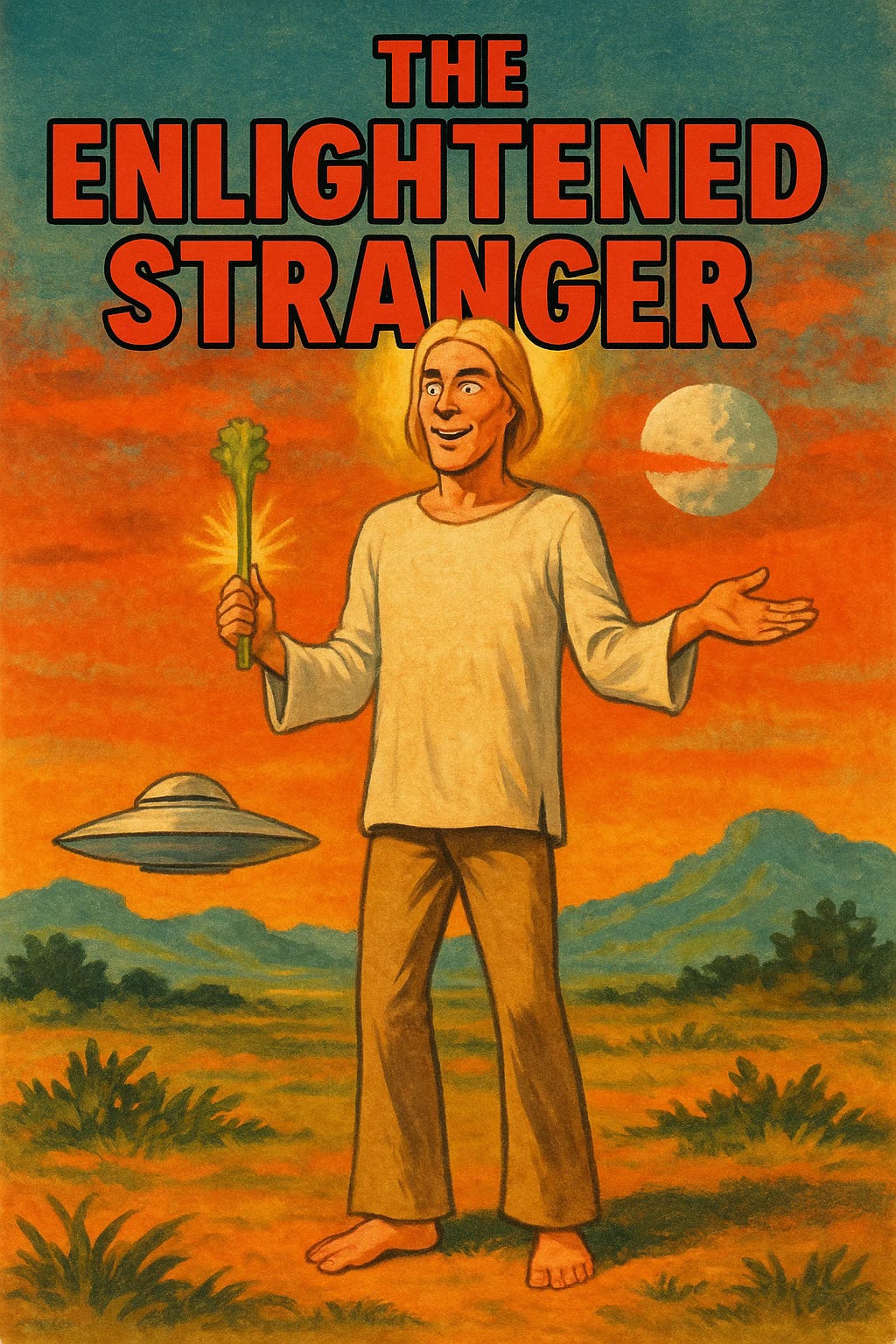
The Enlightened Stranger: TV’s Forgotten Obsession With Future Men
The 1970s had a peculiar little sci-fi fixation—an archetype I’ll call The Future Man.
Not Steve Austin. Not Buck Rogers. And no, there wasn’t actually a series named Future Man— I think… (googlegooglegoogle) — at least, not in the 70s.
I’m talking about those serene, soft-spoken “evolved” humans who turned up on TV to warn us about pollution, greed, capitalism, racism, wartime thinking, insufficient hugging, or whatever else was in the national doghouse that week. These enlightened beings were always appalled by human failings, always white, often barefoot, occasionally glowing, and frequently amnesiacs. They tended to wander around America dispensing wisdom like a granola-powered Jesus with light telekinesis.
The trope sits somewhere between Mister Spock and the Soviet ideal of the perfected New Man—filtered through a decade that really believed incense, bell-bottoms, pet rocks, and a little meditation could rewrite human nature. You can see the lineage: Klaatu from The Day the Earth Stood Still is clearly their granddaddy. But the 1970s Future Man was drenched in hippie mysticism in a way only Boomers could manage.
Boomers didn’t invent political protests, didn’t invent drugs, didn’t invent space exploration. But they did invent a lot of deeply questionable television. I’ll give them that.
And standing proudly among the macramé, lava lamps, and shag carpets that smelled…funny, was the Future Man.
There was another influence at work, too: the Ancient Astronaut craze. For those who weren’t there (and congratulations), Erich von Däniken’s Chariots of the Gods? (1968) convinced a sizable chunk of the population that aliens had built everything from the pyramids to Stonehenge to the Nazca Lines and then noped off into space, leaving the Freemasons in charge for some reason. Today this stuff wouldn’t survive three hostile Redditors and a meme.
(Futureman Herald note from 2025: whoops—turns out it survived just fine.)
Most of the shows I’m about to mention never made it to syndication because they didn’t hit the magic 72-episode threshold. Some didn’t make it to episode two.
Let us begin.
The Questor Tapes (1974)
Future Man: Questor
This is the closest any of these shows came to being genuinely good. And yes, the blame—or credit—lands squarely on Gene Roddenberry’s doorstep.
Roddenberry had already dipped a toe into the “evolved quasi-human shepherding mankind” idea with Gary Seven in Assignment: Earth, (more on Gary Seven next week, oh boy are you getting more on him). When Star Trek got axed, this was the first project he managed to sell: a TV movie about an android in search of his mission and his maker.
The creative team was a mini-Star Trek reunion—D.C. Fontana providing the story, Gene L. Coon writing the screenplay. The result was a one-off movie that still works as a self-contained little slice of 1970s speculative fiction.
The premise: Nobel-winning weirdo Emil Vaslovik attempts to build an android, mysteriously disappears, and leaves behind components so advanced the world’s brightest minds can assemble them but not understand them. Think Enlightenment-era watchmakers handed the exploded parts of a cruise missile.
Naturally, they screw up the programming tape. Half of Questor’s data is erased; the backup tape the team improvised does nothing. For a moment, everyone shrugs and goes home.
Then Questor gets off the table.
He adjusts his appearance, kidnaps the only scientist who knew Vaslovik personally, and sets off on a race-against-time fetch quest: if he doesn’t find his maker, the built-in nuclear failsafe detonates.
What follows is pure Roddenberry—and pure proto-Next Generation. The finale reveals Vaslovik himself is an android, part of an ancient lineage left behind by mysterious “Masters” to quietly nudge humanity along without intervening. Prime Directive? More like Original Directive.
It’s not hard to see Questor’s DNA in Data—right down to the immortal line:
“I am fully functional in every way.”
Of course Roddenberry carried that one over.
Where to Watch: DVD; YouTube copies get nuked harder than a Questor failsafe.
Man From Atlantis (1977)
Future Man: Mark Harris
If Questor Tapes was decent, Man From Atlantis was the opposite of whatever “decent” is.
Patrick Duffy stars as a web-handed amnesiac aquatic man who speaks in contraction-free sentences because writers in the 70s mistook that for depth. He joins a marine research agency and has weekly underwater problems, environmental angst, and the occasional villain who tries to melt Antarctica.
The writers had no idea what to do with this concept, so they threw everything at the wall. Time travel? Sure. Mark meets his Old West doppelganger (evil, because he uses contractions). Literary intervention? Of course—Mark enters Romeo and Juliet and decides to fix Shakespeare.
Costar Belinda J. Montgomery crashed out before the season ended, and hired a lawyer to help break her contract. Which says pretty much everything.
Only Victor Buono, chewing scenery as a recurring megalomaniac, is worth the price of admission.
Where to Watch: DVD or Prime Video. YouTube is locked down harder than Beijing’s firewall—which is fitting, because this show was inexplicably beloved in China.
The Fantastic Journey (1977)
Future Man: Varien
TV executives in the 70s hated sci-fi. They remembered what Star Trek cost. They preferred police dramas, medical dramas, and anything where sets didn’t need blinking lights.
Then George Lucas broke the world in 1977.
Suddenly every rejected sci-fi pitch got yoinked out of the trash can. One of those was The Fantastic Journey, which can only be described as Earthbound Star Trek with dollar-bin mysticism.
D.C. Fontana produced and showran the series, which explains why it occasionally feels like Trek in bell-bottoms.
The setup: a research expedition enters the Bermuda Triangle—a location Ancient Astronaut fans believed was a cosmic revolving door. Flight 19 vanishes in a prologue. A ragtag party is assembled: a scientist dad, his precocious Disney-movie son, a black doctor, and “The Woman” (70s diversity quota: filled). By the end of episode one, the dad is gone and replaced by Future Man Varien—a glowing tuning-fork-wielding psychic whose abilities include “whatever the episode needs.”
Roddy McDowall shows up later to class up the joint with theatrical overacting.
Each week the gang hits a dimensional portal, has an adventure, then exits into the next zone. It was trying—honestly trying—to be better.
Unfortunately, it aired between The Waltons and Welcome Back, Kotter and was preempted constantly. That’s TV death.
Where to Watch: DVDs and some VHS rips on YouTube. Not policed. Probably because no one remembers it exists.
The Phoenix (1982… sort of)
Future Man: Bennu of the Golden Light
Technically early 80s, spiritually peak 70s. The pilot was developed in ’79 and it shows.
A golden-tan Judson Scott plays Bennu, an alien buried for centuries under a Mayan temple who emerges with Jedi-lite powers and an amulet the size of a dinner plate. Bennu is, naturally, an amnesiac seeking his partner Mira (insert Kpop Demon Hunters joke), who can explain his cosmic mission .
He’s hunted by two foes:
• Yago, an evil alien whose power comes from an ominous bracelet;
• And a government agent played by Richard Lynch, doing his best “grizzled man chasing a supernatural fugitive” act.
The pilot is wall-to-wall Ancient Astronaut theology. After that it settles into standard “problem of the week,” which doomed it. ABC killed it after four episodes.
Where to Watch: YouTube, because no one’s fighting over these rights.
Galactica 1980
Future Man: Doctor Zee
Battlestar Galactica had always flirted with von Däniken themes—ancient gods, quasi-Egyptian design, cosmic destiny. But Galactica 1980 took everything weird about the original and slapped a bowl haircut on it in the form of Doctor Zee.
Galactica had been monstrously expensive—$20 million for it’s one season in 1970s money. So when ABC resurrected it as a low-budget mid-season replacement, everything was reused: props, costumes, stock effects. The cast was mostly gone except Adama and Boomer.
Enter Robbie Rist—yes, Cousin Oliver—as Doctor Zee, a hyper-intelligent, mist-shrouded wunderkind with vague psychic abilities. He was supposed to be Starbuck’s half-angelic son. Then scripts changed. Then the actor changed. It was that kind of show.
It was canceled quickly. Only the Starbuck episode has any defenders.
Where to Watch: Why would you do this to yourself?
The Death of the Future Man
By the early 80s, the Future Man evaporated almost overnight. Generation X wasn’t buying the mystical eco-sage routine. We wanted grittier heroes, more grounded sci-fi, and fewer glowing tuning forks.
Still—there’s something charming about that era’s earnest belief that the future would arrive to scold us lovingly into enlightenment.
They were wrong, of course.
But they gave us one hell of a time capsule.
Discuss in the Comments Below
Even though it hit in 1981 I think The Greatest American Hero fits snugly into this trope. Aliens give Ralph a superman suit, but he loses the user manual (amnesia) . Ralph Hinckley is a classic liberal school teacher and so is his lawyer girlfriend and all moral judgement is seen through that lens. Robert Culp plays the FBI handler. The cosmic joker sync is that a certain John Hinckley Jr. shot Ronald Reagan on nearly the same date as the premier. William Katt (TGAH) auditioned for and was seriously considered for the role of Luke Skywalker, which proves that there really is a Force.
"...there’s something charming about that era’s earnest belief that the future would arrive to scold us lovingly into enlightenment.
They were wrong, of course."
***Looks around at the Longhouse***
Were they, Mr. Herald? Were they?