

Dark First Impressions: DC’s Lanterns

This show lost me completely in the first five minutes. It wasn’t getting me back.
HBO is at best uncomfortable with taking genre seriously.
Peacemaker was clearly meant to be James Gunn vulgar absurdism, so it got a pass. Creature Commandos was animated and HBO has always been happy to give DC cartoons a pass, they’ve been doing that for years - it’s like Bugs and Daffy so far as they’re concerned.
But Watchmen and now Lanterns?
No, if something is meant to be taken SERIOUSLY then it is going to be no-shit, by Glob HBO serious.
Muted photography. Damaged protagonists. Deliberate pacing. Psychological trauma. Moral ambiguity. Naturalistic dialogue. Institutional corruption.
Shining goodness versus absolute evil? Superheroes costumes and spectacle? Outright heroism? Only if Zaslav is specifically demanding it. And only the absolute minimum necessary to keep the bungie-boss happy, we’ll worry about keeping a smile on Ellison’s face when and if we have to.
This show is up against HBO’s institutional instincts and aesthetic inertia.
It’s Not TV… It’s HBO
When Home Box Office first set up shop, cable typically only had about 12 channels and it was really more of a local sports channel than anything else. Time magazine, which believed it or not was a very big thing back then, took full ownership in the 1970s and later that decade started aggressively pre-purchasing movies. Basically, they were slamming funding into Hollywood in exchange for fast tracked broadcasting rights; for example Star Trek the Motion Picture was aggressively pre-sold and HBO was one of the biggest buyers. It may well have saved Paramount from the cash flow crisis that Roddenberry nearly buried the studio in.
In the 1980s, HBO began to feel just a little pressure from the multiplying cable channels so they leaned hard into what UHF channels legally could not - blatant profanity, explicit violence, and gratuitous nudity.
Cussing, Blood and Boobs were the hallmarks of pay-cable in the 80s and into the 90s. Tales from the Crypt, Dream On, and “documentaries” like Real Sex, America Undercover, and Taxicab Confessions, gave audiences a motivation, (if not an elevated one), to call the cable company and subscribe.
But by the mid-1990s, the premium channels had a problem. The Cable Cambrian Explosion was giving viewers more choices than ever, there was a Blockbuster Video on every street corner, and studios were finally selling movies at genuinely “yours to own” prices. The market niche that HBO and its competitors had spent twenty years building was vanishing beneath them.
Jeff Bewkes, the new Chairman of HBO saw the problem and clearly stated in 1996 that he intended to increase the “amount and quality and impact” of originals specifically to give subscribers “something they can’t get somewhere else.”
In 1997 HBO launched their prison drama, Oz, which served as a proof of concept. In 1999 The Sopranos began to cleanly establish the channel’s reputation for premium content. But Band of Brothers was the real gamble and the real payoff.
All of the hallmarks of the HBO prestige school were present in the Spielberg-inspired miniseries about the wartime exploits of Easy Company: feature-film production values, enormous budgets, top-shelf acting talent, long-form storytelling, and above all else, extraordinary creative freedom, and bit-crushed color. HBO hired people it trusted, gave them the money to make something that didn’t look like television, and then largely got out of their way.
It was kind of a callback to the old “Television Event” miniseries of the 1980s, but with genuine motion-picture production values. It was the old “for the next several nights, this is what America will be watching” model… But not if you aren’t a subscriber, so call your cable company now. It was a high-risk power play, and meant to be an enormously expensive loss leader…
Wrong call. Welcome to the DVD Boom!
It cost maybe $1.50 to produce and ship a single DVD movie unit. However, a single season series like Band of Brothers only cost HBO $4.50 per boxed set to ship. Do you realize the kind of thievery HBO was able to indulge in once Band of Brothers hit the shelves at Best Buy? Because I do. I bought the damned thing for my father-in-law at Christmas: $119.99 for the full season.
Darklings: You’re always going off about having to factor in the Theatrical Split and Marketing. I’m estimating that at $0.00.
The Dark Herald: You nailed it. A production layout of $120 million was a lot but Band of Brothers lifetime revenue was around $250 million with no theatrical split.
And HBO had a lot of shows it would put on the market before and after the DVD collapse: The Wire, Carnivàle, Deadwood, Rome, Generation Kill, John Adams, Boardwalk Empire, The Pacific, Game of Thrones, True Detective, Westworld, Succession, Chernobyl, and that is just a cursory survey off the top of my head.
HBO held on to prestige programming even after the DVD boom collapsed because by then prestige served a drastically more important purpose. It was the network’s legitimacy engine.
Credit where it’s due, HBO really was trying to sell quality. Production costs generally came back down from the lunatic heights of Deadwood and Rome (Game of Thrones excepted), but the underlying proposition remained: subscribe to HBO because this is where the good stuff is.
But what happens after a quarter century of “prestige format” transforming into “the house brand.” Well, you make sure it gets injected into just about everything that is going to be “serious.”
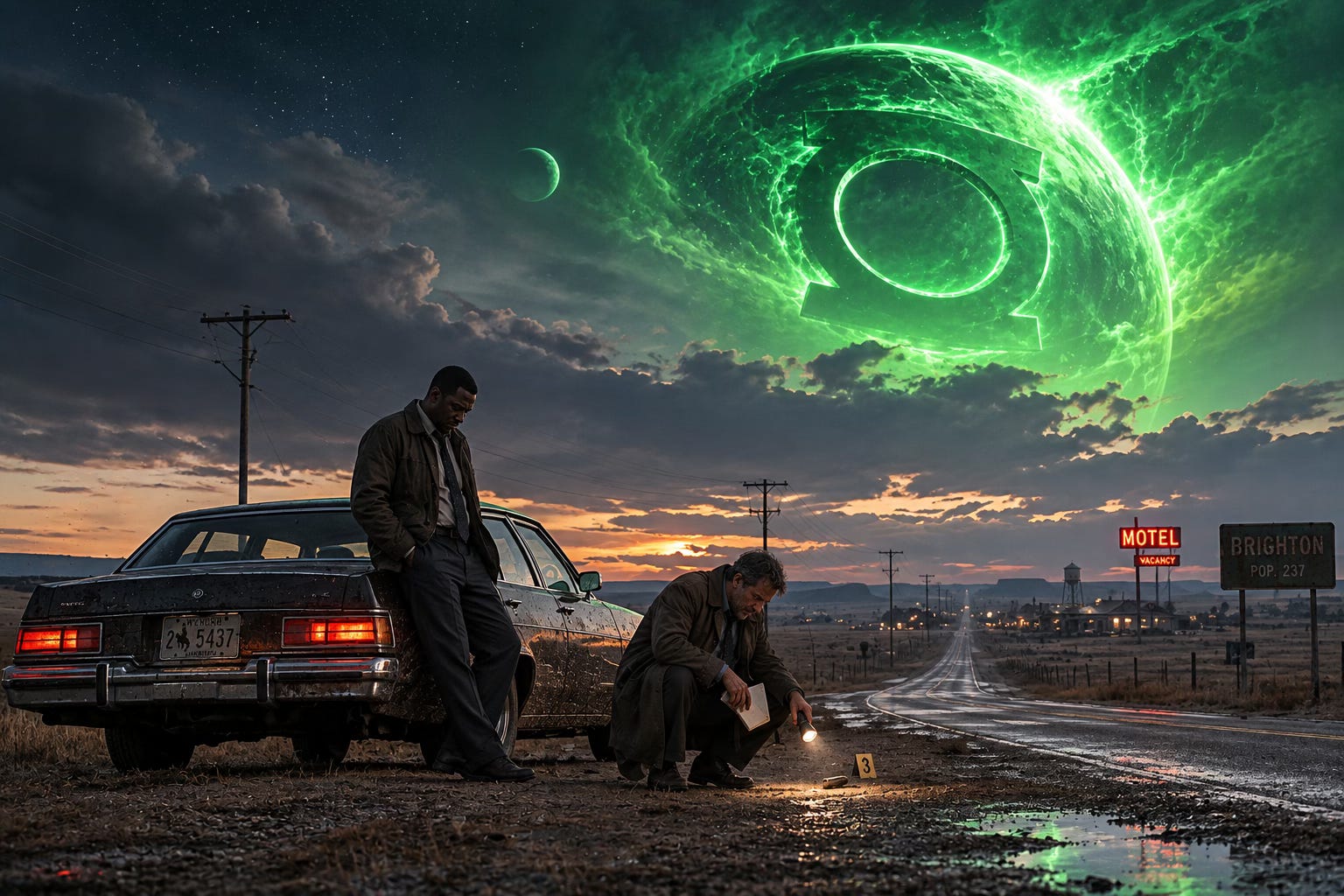
Like Lanterns for an outstanding example. They couldn’t even bring themselves to call it Green Lanterns. Sure, that’s what the show is about, or at least supposed to be about. But frankly, it would much rather be True Detective. Everyone keeps comparing this show to the first season of True Detective. I think the comparison is fair. So if you want to watch a True Detective type show, you should watch True Detective… Which is also on HBOmax.
Big Love?
Like I said, this show lost me in the first five minutes and it wasn’t getting me back.
I think the fundamental issue is that Damon Lindeloff was having to describe something masculine and that’s like a virgin trying to describe sex.
It starts in 1996 and adolescent John Stewart is watching an interview on Sixty Minutes (yeah, kids loved that in the 90s) with Hal Jordan. His brothers indicate they will be in trouble if Dad sees them watching it. No idea why, roll with it because I had to. Dad does come home and catches them watching Sixty Minutes which I will grant, merits merciless beating of your man-children, but it’s probably already too late if they are doing things like that.
Dad is a Sergeant Major in the Marine Corps. Mid-1990s forest pattern utilities, name tags on the uniform. Green tee-shirt. Okay they got the period right. Dad orders John outside, with threatening music rising. You think he’s about to be horrifically beaten… Yeah, I wish.
Dad draws a concealed service M9, and shouts “Are you afraid?!” As John puts an apple on top of his head.
“No sir!”
He isn’t really going to…
BOOM!!!
Father and son hug.
I was irresistibly reminded of John Scalzi’s “I owe you a blowjob” line. This is the result of a writer who is completely devoid of masculinity trying to write something manly.
It’s the details that make this so much worse. If he’s a USMC Sergeant Major in 1996, the show is asking you to accept a fairly specific social world. A Sergeant Major wandering around base in camouflage utilities with a concealed service pistol was already in a world of career-ending trouble. If it was an issue weapon, it belonged in the armory; he sure as hell wasn’t taking it home. If he was armed in uniform as part of his duties, it would have been issue open carry. The people who actually had authorization to carry concealed weren’t doing it in utilities.
And then he fires the fucking thing.
In a residential driveway.
At an apple balanced on his son’s head.
Now we have witnesses, deafening gunfire attracting everyone’s attention, a high-velocity projectile whose destination after passing through the apple is kind of important but remains unknown, and a Sergeant Major committing an act of such spectacular professional suicide that the MPs would probably be the least of his problems.
This isn’t “hard-ass old-school Marine parenting.” It’s a writer who knows that Marines are associated with guns and has no idea what that actually means. That’s where the prestige-drama shorthand becomes visible. The writer wants to communicate several things very rapidly:
John’s father is a career Marine, therefore harsh discipline, therefore toxic masculinity, therefore John learned to master fear, therefore future Green Lantern.
So, we pick up in 2016, John Stewart is now Hal’s apprentice Green Lantern… Yeah, I know, I know… The Ring doesn’t work that way, just roll with it some more, I’m not promising it will make sense in the end but at least we’ll get to the end faster.
Hal maintains an abusive relationship with John. A whole, “you are not worthy and never will be,” thing. The whole point of this series is, I suspect, finding out if Hal means it or not.
Watch the trailer and you’ll see Hal try to kill John in a car wreck, it doesn’t work of course because the rest of the series would be pretty dull otherwise. Hal takes off for a town in Nebraska with aliens in it who are acting as an immigration allegory. It’s set in Wyoming but they’re calling it Nebraska, because honestly, if the only places you know personally are New York and Los Angeles, then everything in between is basically the same anyway.
True Detective stuff happens until the show is forced to be a Green Lantern thing again, then the superhero stuff resentfully happens.
Yeah, Hal dies at the end but that’s in 2026 and apparently Nathan Fillion got Hal’s Ring? I think that was likely canon at some time or another.
Is It Better Than Supergirl?
Yeah it’s better than Supergirl, which means James Gunn was too busy to bone it in the ear.
But “better than Supergirl” is a pretty low bar to clear when you’re carrying the actual Green Lanterns in your title card and can’t even say their name. That’s the tell. HBO didn’t option a superhero property because they wanted a superhero show. They optioned it because Zaslav ordered HBO to make it happen and then HBO handed it to people whose entire aesthetic instinct runs in the opposite direction of what the source material is. You end up with a show that’s ashamed of its own premise, apologizing for the ring and the oath and the primary colors every chance it gets, because somewhere in a note session somebody said the word “elevated” and everyone nodded like that meant something.
Darklings: So is it good?
The Dark Herald: Wrong question. It’s competent. It’s well-shot, well-acted, structurally patient in exactly the way a prestige drama is supposed to be patient. If you stripped the ring out entirely and renamed John Stewart, you’d have a perfectly serviceable eight-episode HBO drama about a Marine’s kid processing generational trauma in a town full of aliens. That show might even be good.
It’s just not Green Lantern. It’s True Detective wearing a green light like a costume it’s embarrassed to be seen in, made by a network that hasn’t trusted spectacle since Bewkes decided prestige was the whole brand. Thirty years later, that’s not a house style anymore. It’s a house limitation. And it’s why the actual superhero part of “superhero show” keeps happening to this thing instead of being the thing.
What it does to Harry Potter is going to be so much worse.
Discuss in the Comments Below
So it's like someone shouting the word "green!" in another room while you watch True Detective, only it's season two.
It blew my mind that a seasoned Marine would not only point a loaded gun in the direction of his kid, but also expected the garage to stop the bullet from whizzing through the neighborhood and killing someone at random. The whole show feels like it was made by someone who worries about guns a lot but also doesn't understand them at all. And definitely refuses to spend any time among the people he's writing about.