

Proud Legions
An excerpt from There Will Be War

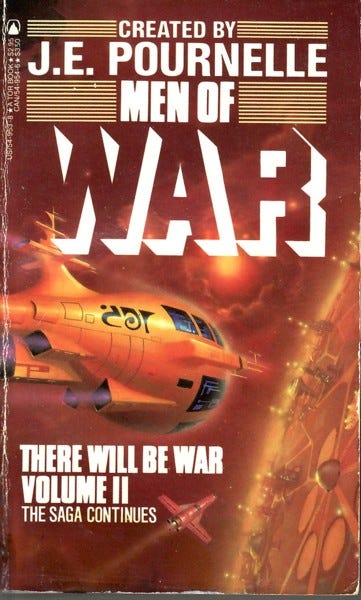
Jerry Pournelle’s There Will Be War anthology series is the greatest military science fiction anthology series of the 1980s. Tor Books published nine volumes from 1983 to 1990. Pournelle would mix fiction and non-fiction in each volume, new stories with reprints. I learned some new things like Pournelle’s “Thor system” of using telephone pole sized tungsten rods dropped from space for bombardment.
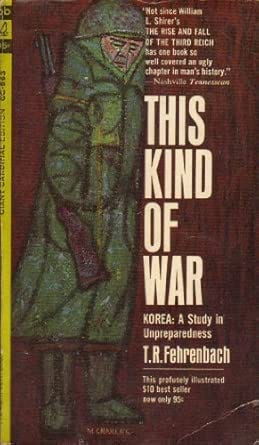
One of the non-fiction pieces, also a reprint was “Proud Legions” by T. R. Fehrenbach in Men of War (There Will Be War Volume II, 1984). This is an excerpt from Fehrenbach’s Korean War history This Kind of War (1963). To give an idea of Fehrenbach’s writiting style:
“They were not Indians. Another and very different race first took possession of Texas soil. This race passed down the few unglaciated valleys of the north, seeking the sun, and the grass and game that followed the sun. . .They were not Mongoloid. The skulls they left behind are longheaded, more long-headed than any race of modern man. They had massive teeth, and their leg bones were flat and curved. They were more unlike American Indians than white men are differen from Chinese, and they may have been a Caucasoid race that roamed east out of Central Asia in the human dawn.” (Lone Star, 1968)
“The Scotch-Irish were once Scots borderers in the British Isles, they mixed race of Dane, Gael, and Saxon of the Teutonic Scottish south. They evolved as a tough, stubborn, dour people, conditioned to border war. They fought the English for generations, though they themselves were English speaking from the Middle Ages.” Lone Star.
Fehrenbach made the case for long serving professional soldiers if the United States was going to engage in empire.
“Any kind of war short of jihad was, is, and will be unpopular with the people. Because such wars are fought with legions, and Americans, even when they are proud of them, do not like their legions.. . For legions have no ideological or spiritual home in the liberal society. The liberal society has no use or need for legions.
Before 1939 the United States Army was small, but it was professional. Its tiny officers corps was parochial, but true. Its members devoted their time to the study of war, caring little what went on in the larger society around them. They were centurions, and the society around them not their concern.
Without its tough spearmen, Hellenic culture would have had nothing to give the world. It would not have lasted long enough. When Greek culture became so sophisticated that its common men would no longer fight to the death, as at Thermopylae, but became devious and clever, a horde of Roman farm boys overran them.
But the sociologists are right – absolutely right – in demanding that the centurion view of life not be imposed upon America. In a holy, patriotic war – like that fought by the French in 1793, or as a general war against Communism will be – America can get a lot more mileage out of citizen-soldiers than it can from legions.
No one has suggested that perhaps there should be two sets of rules, one for the professional Army, which may have to fight in far places, without the declaration of war, and without intrinsic belief in the value of its dying, for reasons of policy, chessmen on the checkerboard of diplomacy; and one for the high-minded, enthusiastic, and idealistic young men who come aboard only when the ship is sinking.
The other answer is to give up Korea-type wars, and to surrender great-power status, and a resultant hope of order – our own decent order – in the world. But America is rich and fat and very, very noticeable in this world. It is a forlorn hope that we should be left alone.”
I exchanged some e-mails with Fehrenbach in 2001. I had a hunch he had read Robert E. Howard and he confirmed that he had. I have read his histories on the Comanches, Mexico, Texas. My paperback copy of This Kind of War is from the mid-1960s and has split apart. I need to get a hardback as I reread portions of the book every few years.
He told me that the “Proud Legions” chapter has been excerpted a few times and quoted many times. The United States did go from a conscript to a legionary model. There is a (not very) future war novel called Proud Legions by John Antal from 2000.
.
There's a tenth volume in the *There Will Be War* series:
https://www.amazon.com/There-Will-Be-War-Historys/dp/9527303249/
Also, if you liked Fehrenbach and want to explore these issues further, you might want to take a look at Sam Huntington's *The Soldier and the State*, his discussion of the difficulty of maintaining the uneasy balance of civil-military relations in a liberal democracy:
https://www.amazon.com/Soldier-State-Belknap-Press-ebook/dp/B07FK2PXP9/
There's another book on the same topic that was published more recently, titled *Armed Servants*, but I confess I've not read it:
https://www.amazon.com/Armed-Servants-Oversight-Civil-Military-Relations/dp/0674017617/