

RE:View - The Fifth Element

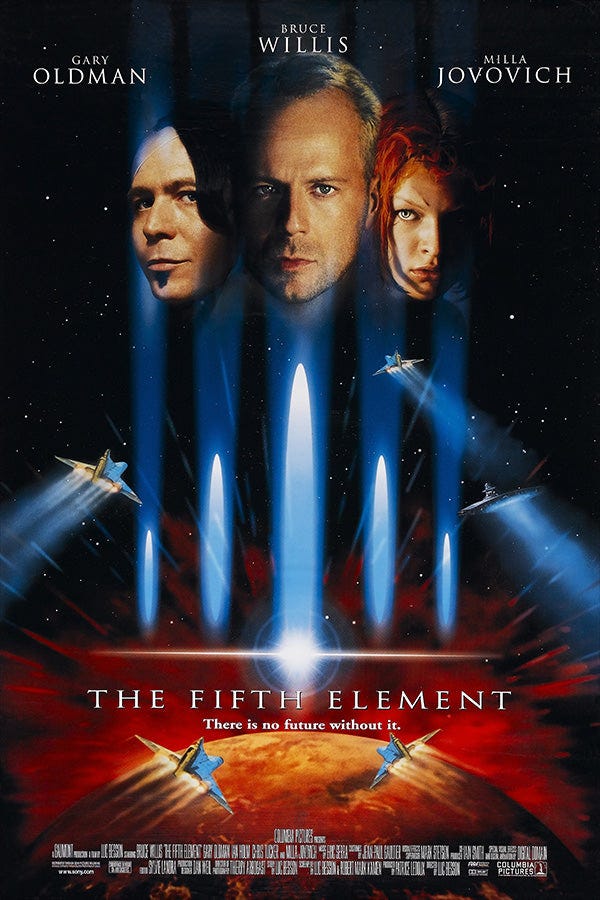
Valerian and the City of a Thousand Planets is an intriguing failure because Besson was able to make the movie he had wanted to make his entire career… And he’d already made a better version of it twenty years before.
Before talking about why The Fifth Element works, it’s useful to talk about what happened when Luc Besson tried to do it again.
Valerian and the City of a Thousand Planets (2017) should have worked.
On paper, it had practically everything Besson could possibly want. A gigantic budget. A gloriously ridiculous science-fiction universe with a deep back lore. Spectacular production design. Aliens everywhere. A comic-book property that gave him permission to indulge every visual impulse he’d ever had. Even, Cara Delevingne, who absolutely looked the part of Laureline. Then Dane DeHaan walked into the room, and the two of them proceeded to generate about as much romantic heat as a pair of siblings arguing over who gets the front seat.
This was where the movie failed, Valerian desperately needed us to believe these two people were passionately, even irrationally, devoted to each other. Instead, every flirtation felt like dialogue they had been forced to say. Delevingne could pose, DeHaan could brood, and neither could sell desire for the other.
That failure becomes considerably more intriguing when you go back to 1997 and watch Bruce Willis and Milla Jovovich. Because Korben Dallas and Leeloo have chemistry.
Lots of it.
And it should not have worked. At all. Leeloo barely speaks English for most of the movie. Korben spends most of his time being completely bewildered by her. Their courtship takes place while people are shooting at them, planets are being devoured, Chris Tucker is screaming into a microphone, and Gary Oldman is chewing scenery hard enough to eat his way through the side of the sound stage. But you never doubt for a second that Korben is falling hard for this strange orange-haired girl who has crashed through the roof of his taxi. Just as important, you believe that Leeloo already loves Korben.
That matters because beneath all the flying cars, Jean-Paul Gaultier costumes, blue opera singers, ancient aliens, exploding spaceships, and whatever the hell Ruby Rhod is supposed to be, The Fifth Element is built around something shockingly old-fashioned.
It’s a love story.
That was the critical fail for Valerian because if you don’t buy the love story, none of the rest of the movie works.
The Fifth Element is a Comic Book Movie
A very French comic book movie. La bande dessinée is a comic book culture that is actually valued by France as the “Ninth Art.” It enjoys scholarly support, and to a degree government backing as an artform unique to the French. It has genuine prestige. If a That Guy sneers about BD comics being kid stuff everyone else would clown on him for being a beauf and a simplet in an extremely French manner.
The Ninth Art is distinct for its emphasis on authorship, craftsmanship, and a much larger format than American 24 page pamphlets. BD comics come in fifty page albums with hard covers, high-quality paper and expensive printing, prioritizing shelf-life and collectibility. The longer format allows for deeper narratives, developed at a slower pace and no matter what your interest is there is probably a bande dessinée for you. It favors auteur culture and creators. If you’ve ever read Heavy Metal, you can tell it take deep dives into avante garde science fiction… And anybody who saw it in 1997 knew they were looking at something out of Heavy Metal.
The Perfect Year
The Fifth Element would have probably failed if it had come out in 1987 and it just wouldn’t have been made by 2007. Generation X was the primary audience, and my generation’s visual literacy leaned strongly into the uncomfortable. The stuff we weren’t allowed to read as kids but did anyway was Savage Sword of Conan and Heavy Metal. Streamline and Manga Video VHS tapes had given us a taste for things like Akira, Ghost in the Shell, Wicked City, and Ninja Scroll.
We were the first generation to be casually interacting with people from other countries over an internet that wasn’t being corralled at all. It gave us tastes that were a lot more global in flavor. And we were a bit more edgy than what had come before, that joke about Generation X either went to rehab, jail or the military didn’t come from nowhere.
Luc Besson hired Jean-Claude Mézières, the guy who has been doing Valerian and Laurieline since it started in 1967 to do the art design, it kind of showed.
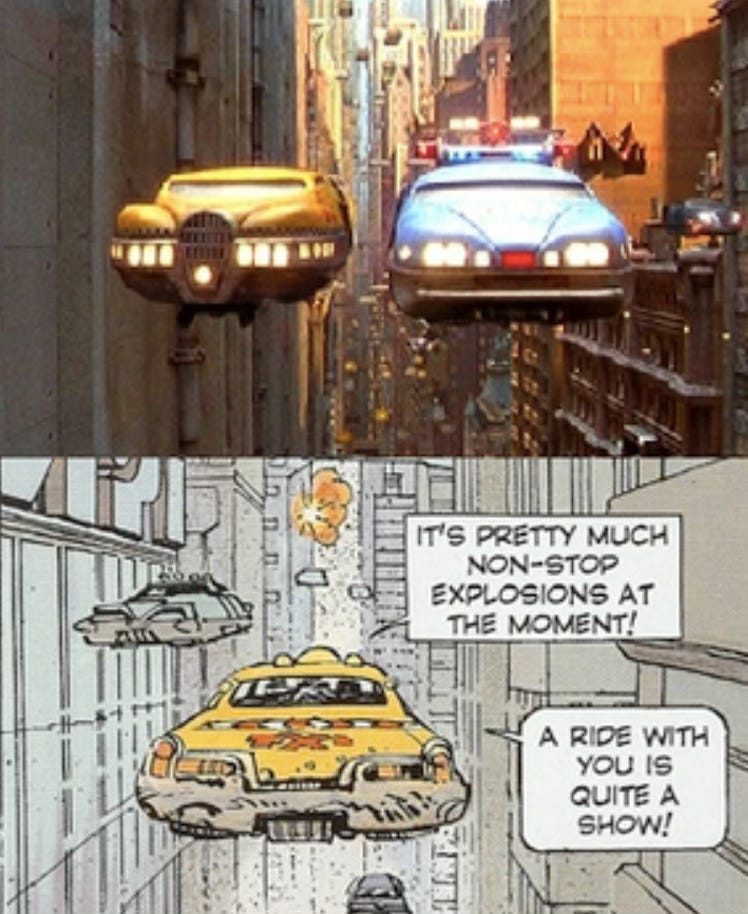
Yet for all of its apparent excess its aesthetics were surprisingly restrained. I know that sounds strange when you think of The Fifth Element but compared to Besson’s other movies it was. Possibly it was the limits of technology, or budget, or just little self-doubt, in his first high budget science fiction film. In his Valerian he got lost in his own aesthetic, in his Dracula you just can’t take it seriously because it reaches monty python levels of absurdism. This wouldn’t be bad if he hadn’t proved himself capable of self-restraint in workslike in The Extraordinary Adventures of Adèle Blanc-Sec where you got just the right amount of Besson. Which is also what you got with The Fifth Element.
The movie starts at the turn of the last century. A professor is in a tomb. A young and rather bankable, at the time, Luke Perry is there so the name Luke Perry can be used in the advertising.
The Professor gives us a quick overview of the situation. Evil will come to wipe out the universe but will then be opposed by four elements with a fifth element in the middle of them that will destroy the Evil… Hopefully.
A priest, (although of what religion we never really find out), shows up. There is a lot catholic imagery associated with the “50th-Level Parish” but it doesn’t get too nailed down to any Christian theology. Which the priest proves by immediately trying to murder the Professor. The Priest doesn’t seem to want to do it but they now, “know too much.”
Also, the priest didn’t need to bother, because aliens (the Mondoshawan) pick that narratively convenient moment to show up and kill Professor. They’re design was the first hint of what you’d be getting. ancient ritual rendered through extravagant French comic-book retro futurism. These bronze armored turtle-ducks looked both unknowably ancient and impossibly advanced. The alien that killed the professor is himself promptly killed, in his case by being crushed to death, and the Mondoshawan didn’t regard his own death as important because “only life is important.”
This was a pretty gutsy way to start the movie. In this age of Marvel Morality it’s becoming increasingly difficult to remember there was a time where an audience expected a movie to know right from wrong and act accordingly. Killing the professor for “knowing too much” is wrong but the alien’s immediate self sacrifice lets you know that the Alien and their allies are just as ruthless when it comes to themselves. Unlike the Professor, the first priest regards the Alien’s death as a tragedy, and vows to continue the mission.
Time skip and the Evil has returned.
That’s also kind of refreshing. There were no shades of grey to be found. This adversary was The Adversary. An embodiment of destruction. It has no backstory, no motivation beyond annihilation. It is simply Satanic Evil.
The Priest
We meet our second priest, Father Vito Cornelius, played by Ian Holm. He advises against force and the president almost listens. The military of course does not and the task force is effortlessly destroyed.
This crisis is ultimately a spiritual crisis
The Fifth Element was a story with just a (blessedly) few point-of-view characters each functioning as an archetype.
Father Cornelius is the one character that is close to failure but it’s not because of the always excellent Ian Holm. The problem is the nature of Cornelius himself. He is the Priest at his core he is meant to be a guide and exemplar. The problem is he keeps trying to take a role that simply is not his, a guardian… the Knight.
There are also a few secondary archetype characters that act as reinforcers to the major archetypes, but they aren’t point-of-view characters in their own right.
General Munro and The President, they are “temporal authorities” who are rendered powerless in face of a spiritual crisis.
The Mondoshawan are “angelics” as custodians. I’ll get to the rest as they come up.
A Mandoshewan ship bringing back the Fifth Element is attacked and destroyed. The only thing recovered is an armored gauntlet with a hand in it. Due to unique science magic, this perfect being can be reconstructed on Earth. Giving Leeloo the Savior both a virgin birth and generations of cosplayers a simple but chilly outfit.
She promptly escapes.
The Knight
Now we finally meet Korben Dallas. The Knight and also the Lover. Besson also gives Korben something that Valerian never convincingly possesses. The Delta Male who saves the universe is a hopeless romantic.
We know that before Leeloo ever appears. His introduction presents the usual Bruce Willis package: divorced, broke, world-weary, living alone in a shoebox apartment, driving a cab through a future that has apparently disappointed him in every conceivable way. But underneath all of that is something surprisingly innocent. Korben still wants to fall hopelessly in love with the right girl.
Then the right girl literally falls out of the sky and through the roof of his cab.
What follows works because Korben never becomes cynical about what is happening to him. He tries to kiss Leeloo too soon and gets his choke chain pulled tight for it. He knows immediately that he was in the wrong. Worse, he is certain that he’s blown it forever. We all sympathized, in that pre-social media age, every guy sooner or later read the signals with more optimism than accuracy, and ended up embarrassing himself. You don’t think Leeloo was wrong to stop him, but you feel terrible for Korben anyway.
And when Korben gets a second chance to be with Leeloo he throws his life away to chase after her.
Granted, Korben Dallas does not have a lot to throw away. His apartment is a closet, his four cigarettes a day are 80% filter, his mother drives him insane, his marriage is over, and his career prospects appear to consist largely of accumulating points on his driver’s license.
But when you have less you value it more. Going from little to nothing is a bigger risk.
That’s what separates Korben and Leeloo from Valerian and Laureline. There is a simple purity to their relationship. Leeloo is almost childlike: enormously intelligent, incredibly capable, physically perfect, but emotionally she is encountering humanity for the first time. Whereas Korben is the battered veteran who has already encountered far too much of the world. Yet Korben has retained something unexpectedly innocent himself. He still believes there is a girl out there worth falling completely in love with.
Then she falls through his roof.
Bruce Willis understood exactly what movie he was in. He doesn’t underplay it, he doesn’t parody it, he just believes it. That is way harder than it sounds.
A Horrifying Vision of Things to Come
Space Operas aren’t meant to be serious dreams of tomorrow and The Fifth Element for the most part isn’t.
Flying 1960s cars: miss.
Interstellar tourism: miss.
Artificially reconstructed Supreme Being: miss.
Ruby Rhod:…
Nothing. But. Net.
Besson didn’t merely predict the influencer. He got the freaking psychology right! Performative personality, constant broadcasting, sexual exhibitionism, parasocial intimacy, everything becoming content, and absolutely no desire to assume any responsibility at all for his actions.
And the best part is that Ruby isn’t even particularly malicious. He’s just catastrophically self-involved. He doesn’t want power. He doesn’t want to conquer anything. He wants attention, sex, luxury, an audience, and that’s it. That’s the part that puts Dennis Rhodman to shame. In 1997 it was satire. In 2026 it’s a job description.
However, Ruby Rhod is a functional archetype in his own right. He does have a reason to be there. He is The Fool. However, a Fool can have vitally important sub-functions which Ruby genuinely has.
First, Ruby is the Fool as Herald. He’s the one yelling, “make way for my man Korben Dallas! He is the winner… He is the One!”
Second Ruby is the Fool as Witness. The world is ending and he is seeing all of it and broadcasting all of it. “This I have seen with my own eyes and witnessed the truth of it.”
The False Prophet
Jean-Baptiste Emanuel Zorg. His name in English being literally, John the Baptist God-with-Us… uh… Zorg. While he is not the Anti-Christ himself, he is the one that prepares the way and this name fits that function perfectly
As far as I can tell there is no hidden meaning in the last name beyond Besson finding the phonetic appropriate.
Zorg and Korben never interact once in the movie. He thinks he’s the Savior’s adversary but that isn’t his job at all.
Zorg is a blind philosopher. He can make arguments about the beauty of destruction but can’t seem to wrap his head around the fact that he’ll be destroyed too.
The False Prophet’s antagonist is always going to be The Priest. That is the only major character Zorg confronts directly. It’s intriguing because during that meeting Zorg starts choking to death on a cherry. None of his devices or bizarre mini-elephant can rescue him. The Priest gives him a small sermon first and then saves him. But interestingly it’s not out of compassion, it’s because the False Prophet’s purpose hasn’t been fulfilled yet.
You see, Zorg is under the curse of all False Prophets. All of his actions, no matter how wicked in intent, are ineffably bent back upon themselves until they inevitably push the divine plan forward.
The False Prophet can never destroy the plan he believes he’s defeating. His every success becomes another step toward his own failure.
The Diva
It can be difficult at first to tell why this character is being treated with such reverence. She’s just a pop-opera star right? Well, no. There is a lot of Catholic imagery in this film and you can’t have that without the most Catholic thing of all, the Virgin Mother. The Stones are removed from her abdomen, that wasn’t just an uncomfortable way to smuggle them, it gave these instruments of salvation a virgin birth.
When she dies, her concern is for Leeloo not herself. She tells Korben the most important thing that he has to do for her, and it is to give her his love. Which is what ends up saving the universe.
The Savior
It’s a sad thing that Milla Jovovich is viewed as bit of joke today because of all the action roles she’s had over the years, she’s become hopelessly typecast as the gun-fu zombie shooting woman. That is a shame because when she was in her twenties she would truly commit to a role. I can’t think of anyone in 1997 who would have been a better Leeloo. She absolutely sold the innocence, alieness, and blank-slate intensity of a being who is both thousands of years old and also a newborn.
Leeloo isn’t merely the Fifth Element. She is the Savior. Leeloo is physically perfect and mentally extraordinary, but spiritually she is completely unequipped for humanity. She learns English in hours, masters technology almost instantly, and can dismantle an entire squad of Mangalores without breaking a sweat. Yet the one thing she cannot understand is why humanity deserves to survive.
That question becomes the true climax of the film.
When Leeloo downloads the whole of human history into her mind, she sees Auschwitz, Hiroshima, genocidal war, and endless cruelty. She questions her purpose: why should humanity survive?
Only Korben can answer that question.. He simply tells her he loves her. In a lesser film that would be unbearable slop. Here it works because Bruce Willis and Milla Jovovich have spent two hours convincing us that these two people have fallen completely, irrationally, and desperately in love. The universe isn’t saved because Love is Magic™. It is saved because one perfect being finally encounters something in humanity that makes all of its ugliness worth preserving.
Does It Hold Up?
What made Fifth Element really standout in 1997 was that it was a full-on Space Opera.
As much as that term gets thrown around you’d think there were hundreds of the things but they are honestly super rare. There was Star Wars. There was the original Battlestar Galactica. Buck Rogers in the 25th Century managed a couple of seasons. Flash Gordon made one gloriously campy attempt. Then... not much.
No, Star Trek is not Space Opera. Star Trek asks questions. Space Opera tells legends. Kirk is Odysseus. Korben Dallas is Sir Galahad. That’s a very different thing.
What made The Fifth Element feel so startling in 1997 wasn’t simply that it looked different. It was that it unapologetically embraced Space Opera at precisely the moment Hollywood had largely forgotten how to make one. It isn’t science fiction. Nobody cares how the flying taxis work. Nobody cares about how Leeloo can be reconstructed from a single hand, unless you’re doing your life wrong. The Great Evil isn’t an alien civilization with understandable geopolitical motivations. It’s Evil. Capital “E.” An adversarial force that exists because myths need dragons.
That’s how Space Opera works.
The rules aren’t scientific. They’re mythological. The Fifth Element wasn’t trying to predict the future it was building a myth among the stars. The Fifth Element was and will remain a masterpiece of comic book space opera.
That’s why the movie still works.
It’s why the Fifth Element easily holds up.
Luc Besson spent nearly twenty years trying to make another The Fifth Element. He had bigger budgets, greater freedom, and eventually even the comic that inspired it all. Yet he never quite got there again. It turns out that the greatest Luc Besson film was made at the precise moment when his imagination was still tethered to a story stronger than his indulgence. The Fifth was just the one where Luc Besson finally found the perfect balance between himself and the myth he was telling. In lesser hands, “love saves the universe” becomes a Hallmark greeting-card.
The Fifth Element convinced us it was the only possible ending to its story.
Discuss in the Comments Below
Luc Bensson also had been developing The 5th Element since he was an early teenager. Its bonkers world building worked because even though much of it fit together misshapen play-dough, it had that exact childlike love and care that went into creating it, giving it an endearing quality that’s impossible to impose.
I love your review and mostly concur.
However, comma...
I have one small nit to pick with you--and I speak as someone who was reading /Valerian et Laureline/ as a child back in the 1960s (along with Tintin, Asterix, and a whole host of others, both in book form and serialized in the Tintin and Pilote magazines).
I don't honestly think Cara Delavigne is well-cast--and for much the same reason her counterpart is also miscast.
In the books, Valerian is a fully-formed human being--an adult. Which is part of the reason De Haan flops. He's a broody teenager with impulse-control issues.
But Laureline is also a fully-formed adult--indeed she is one of the earliest SF heroines to be able to go toe-to-toe with Valerian (the comic-book version) when he gets too stupid.
And Cara Delavigne...Just. Doesn't. Cut it.
She's pretty, and quite sexy in a somewhat creepily child-like way. But as Valerian's partner? Nope. Not even a little bit.
They needed to cast someone like Karen Allen as she played opposite Harrison Ford as his foil/love interest in Raiders of the Lost Ark. But of course, that would merely have exacerbated the issue with De Haan, who would have appeared even more as a man-child by comparison.
So for me, the movie fails on both its choices in the leading roles.
But it's still what my late father would have called "a brilliant failure."
One question: you make no mention of the movies in which--for me anyhow--Luc Besson made his bones...the hyperkinetic, over-the-top action movies starting with /Nikita/ (and BTW I think that the Anne Parillaud of Nikita would have made a far better Laureline, but of course by then she'd have been too old).
...Thoughts?