

Why Gen Z Needs a God-Emperor
The Clone Wars and 40K

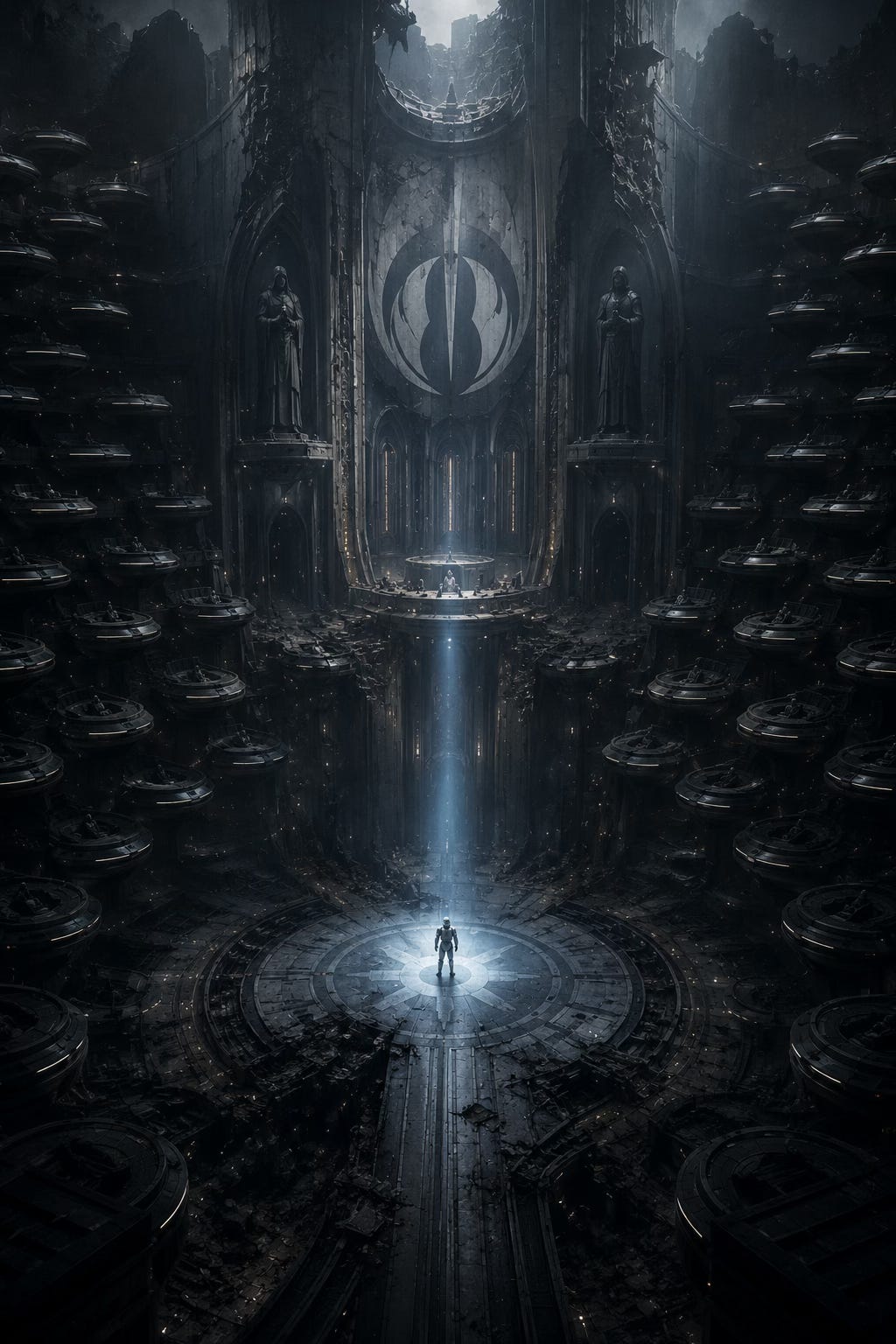
“The Star Wars torch never passed to Gen Z!”
That’s been the common chorus of doom for a while and I’ve been one of the people singing it. The Original Trilogy was and is decidedly a Generation X thing. The Prequel Trilogy, despite its many, many faults did the important work of bringing in a new generation of Millennials.
However, the Sequel Trilogy was a disaster of literally epic proportions. A catastrophe that pleased no one in the end, not even the Reylo shippers. A failure jointly created and owned by Bob Iger and Kathleen Kennedy, it was a cart they were still trying to push forward long after the wheels had fallen off and been sold on Ebay.
But here’s the thing. Iger and Kennedy continuing to pursue this plan that had obviously collapsed put a spotlight on it. Everyone was so focused on this failure to attract Gen Z that we didn’t notice that there was in fact a success waiting in the wings more or less in plain sight.
Kennedy’s plan B kept the focus of attention off of it. The hilariously incompetent High Republic project and its flagship, The Acolyte were so comically bad, you couldn’t help but point and laugh. But again, you were looking someplace else.
With all attention focused on those high profile disasters, it was accepted as a reality that the last popular Star Wars movie had been Revenge of the Sith back in 2005. It had been twenty years since there was a generationally inculcative Star Wars film and that was enough time to skip a generation. Star Wars was dying, that was all there was to it.
Last week, Variety published what was clearly a sponsored puff piece on Star Wars. Its purpose was to prove that Star Wars was still a viable anchor franchise and proudly trumpeted the fact that in the first quarter of 2026 the Star Wars franchise as a whole had 33 billion streaming minutes. That is the kind of large number that invites you to not think about it. So, no thinking about the great big number, please.
But I do things like that.
Anyway, here are the top ten Star Wars Disney+ streams in order.
Andor
Star Wars: Episode IV - A New Hope
Star Wars: Episode I – The Phantom Menace
Star Wars: Episode V – The Empire Strikes Back
Star Wars: Episode III – Revenge of the Sith
Star Wars: Episode II – Attack of the Clones
Star Wars: Episode VI – Return of the Jedi
Rogue One: A Star Wars Story
Star Wars: Tales of the Underworld
Star Wars: The Clone Wars
Two shows on that list were fairly recent drops in the first quarter. Andor and Tales of the Underworld. The latter is not charting at all now, although Andor is proving to have a long tail, not really a surprise that’s what prestige format shows are supposed to do. Although making any real profit is an optional extra, which Andor will never accomplish.
The demographic breakdown was much more interesting… What there was of it… Because again, *Andor is skewing the data, and the purpose of the article was not to provide information but to create a perception.
Gen Alpha (2–13): The Mandalorian
Millennials (30–45): Andor*
Gen X (46–61): Andor*
Baby Boomers (62–80): The Mandalorian
And
Gen Z (14–29): Star Wars: The Clone Wars
Gen Alpha and the Boomers both leaning into the Mandoverse is most likely the result of babysitting grandma and grandpa watching the same show as their grandkids and thanking Glob Almighty that the stupid little rugrat has finally outgrown Baby Shark. Mando is basically a Western with a simple morality structure, unchallenging stories, non-gory violence, and limited profanity. Boomers have always regarded Star Wars as dumb kid’s stuff and The Mandalorian does nothing to challenge that belief.
The data set provided doesn’t say what the number two preference was for Gen X and the Millennials but I’m guessing based on the top ten it’s A New Hope for Gen-X, and The Phantom Menace for Millennials.
But the really intriguing one is Gen Z’s love of the Clone Wars.
It seems to be their firmest preference in a galaxy far, far away. When you look at their other tastes it begins to make sense. The reason they are into the Clone Wars dovetails with their fascination with the Warhammer 40,000 universe.
Why Gen Z Loves the God Emperor
One of the saddest things a Gen X parent has to get across to their kids is that, “It wasn’t always like this.” We can remember the good times because when we were young, we lived in them. It’s our baseline of what the world should be like. Grown-ups who were in charge knew what they’re doing and the national institutions all worked pretty much as advertised. Aberrations were just that.
Generation Z has never lived in that world, their baseline for how it all works is drastically different. They were born after the towers fell. For them, the “normal” world has always been endless, unwinnable foreign wars (Iraq, Afghanistan, Iran) conflicts that predate their memory and dragged on their entire childhoods. A sense that the national high-water mark is behind us, and that they missed the party. Institutions in obvious decline: dysfunctional politics, decaying infrastructure, cultural fragmentation. A background hum of crisis after crisis; financial collapse, terrorism, pandemics, climate anxiety, mass shootings. Where older generations experienced a fall from something, Gen Z grew up in the rubble.
Warhammer 40k is their mythic mirror
The total percentage of Warhammer 40k players aged 34 and under is approximately 60-70% of the total player base. It’s also 90% male (and water is wet).
The 40k universe is not about hope for a better tomorrow, it’s about grim endurance in a universe where: The Golden Age is long gone. Humanity is besieged by enemies it can fight but never truly defeat. The Imperium is a failing, bureaucratic colossus: too big to save, too sacred to reform. Victory is measured not in progress, but in holding the line one more day.
For Gen Z, this doesn’t seem abstract science fiction. It feels like their inheritance. They’ve lived their entire lives under constant surveillance, in securitized schools, watching wars livestreamed in HD. For Gen Z, “The Emperor protects” has the same ironic sincerity as “thoughts and prayers.”
They accept the darkness as the default, not as a fall from grace. Their humor is deeply post-ironic . They can chant “For the Emperor!” both as a meme and with real emotional charge. They don’t need to be convinced that the galaxy is hostile, stagnant, and bureaucratically insane. That is their world.
For Gen Z, Warhammer 40k isn’t nostalgia. It’s mythic realism. It’s a universe that reflects the one they’ve always known, just turned up to 11 and rendered in gothic sci-fi. Where Gen X imagined a grim future and Millennials worried they might lose their golden age, Gen Z was born in the ashes. 40k speaks their language.
Gen Z Did Not Inherit “Heroic Adventure Star Wars.”
For Generation X, Star Wars was our first heroic movie.
For older generations it was The Mark of Zorro, and The Adventures of Robin Hood. For the Boomers it was Easy Rider and Bonnie & Clyde because they’ve always sucked real bad. The Millennials got Harry Potter and the Avengers.
But Gen Z it was “civilizational collapse Star Wars.”
The Clone Wars speaks to them in much the same language as Warhammer 40K does.
The Clone Wars lands differently than the rest of Star Wars because it begins after it’s already too late.
The Prequel Trilogy is structured around a Golden Age the audience never gets to see. The Republic that Padmé defends, that Obi-Wan serves, that the Jedi are sworn to protect — we are told it was once worth protecting. We have to take that on faith, because by the time the story starts, it is already hollowed out. The corruption, the gridlock, the corporate capture of the Senate. These are not developments, they are the opening conditions.
That is not how heroic myth usually works. In heroic myth you see the good thing before it falls. Here the fall is already in progress when the curtain rises. The Golden Age exists only as a fading dream, something older characters remember and younger ones have only ever heard about. Gen Z didn’t need that framing explained. It’s the only world they’ve ever known.
The Republic in the Clone Wars is not the bright, triumphant civilization of the Original Trilogy’s backstory. It is already decaying before the first shot is fired. The Senate is bloated and corrupt. Corporations openly manipulate policy. Emergency powers somehow become permanent. Endless war transforms a small group of guardians into the leaders of vast armies.
The Jedi are not innocent victims of this transformation. While they are genuinely good men, they have become so invested in their own bureaucratic survival and cognitive rigidity that they have lost the ability to see what is happening around them. They become generals, intelligence operatives, political enforcers. They rationalize compromise after compromise because the alternative always seems worse. They are not corrupt in the way politicians are corrupt. They are corrupt in the way institutions get corrupt, through a drift from purpose to procedure. Palpatine didn’t destroy the Jedi, he just signed the paperwork. That is very close to the emotional architecture of Warhammer 40K.
The Clone Troopers themselves feel almost custom-built for the Gen Z identity. They are engineered men bred for endless war, treated as disposable by the very civilization they are dying to protect. Their struggle is not to save the galaxy, but to retain individuality and humanity inside a machine designed to erase both. They are a military caste completely separate from the society they are sworn to protect. That is pure 40K grimdark territory.
The war itself is the final confirmation. The Clone Wars is not a conflict with a front, an objective, or an end condition. It spreads, metastasizes, and consumes lives while the people who engineered it on both sides pull strings from the shadows. The war is not the means to a political end. The war is the policy.
Both Worlds Reflect the Gen Z World
The War on Terror began before they could form memories and outlasted their high school graduations. They watched the rationale shift with every changing breeze, first WMDs, then democracy promotion and when that (inevitably) failed it was counterterrorism, then stability operations (because that at least didn’t tie anyone down to meaning anything). The mission statement updated every few years like a software patch on a system riddled with bit rot. At the end they watched Kabul fall in an afternoon after twenty years and trillions of dollars. The leadership’s reaction was a senile plea to put it all behind us because, “that happened like three days ago, man.”
This is the bridge between Clone Wars, 40K and the Gen Z world.
The Imperium of Man and the Galactic Republic are the same organism in different costumes: vast, aging, nominally noble civilizations that have confused survival with purpose, sustained by the faith of people at the bottom who have no better alternative and are slowly losing even that.
In 40K, the Emperor sits on his throne, sort of alive, sort of dead, but definitely not fixing anything, while billions die in his name every day. In Clone Wars, the Senate keeps voting, the Jedi Council keeps deliberating, and the whole thing burns anyway.
The Clone Wars didn’t need to explain itself to Gen Z. They already knew how it had to end.
Discuss in the Comments Below
Lord of the Rings also fits that narrative, but rather than accept the end and the death as inevitable it challenges heroic men to rage against the dying of the light. When we are introduced to Middle Earth, Gondor's nobility has withered and faded into obscurity, with stewards focused on their tragic end and unable to take action. Rohan is betrayed, its King witless and under the spell of evil forces that let enemy hordes destroy its people and plunder its land, while punishing those who try and fight against it. The dwarves and elves are in decline, strongholds falling as their realms shrink and their time on middle earth comes to an end. But small acts of heroism by ordinary folk are all thats needed to shift the tide. For me at least, and hopefully my fellow Zoomers, there's an underlying belief that even if we're living in the decline of the republic/ Imperium/ whatever, maybe all it takes is the strength to keep fighting, and maybe those better days will come again.
My daughter is at the younger part of the Gen Z age range. Being a female, she's rightly not super into Star Wars. She's cool with watching it, but not a fan. As a Gen X'er, I'm proud of her because she didn't fall for the new Disney Star Wars garbage. That said, I've never broke down the angle you expressed so well in this article. Well done. Thanks for the illumination.