

The Barbarian Westerns
Historical novels by western writers

The American fictional western arrived at the beginning of the twentieth century with the publication of Owen Wister’s The Virginian in 1902. The novel created the archetype of the cowboy as hero. The western story quickly became the mythic literature of the recently closed American frontier. A popular genre in the hands of Zane Gray, Eugene Manlove Rhodes, and Frederick Faust (“Max Brand”) to name a few in the legion of western fictioneers in the form of novels, pulp magazines, and later mass-market paperback books. If J. R. R. Tolkien attempted to create a mythology for England, the western writers created a mythology for the United States of America. Many stories had a setting vaguely late 19th Century time and place. Frederick Faust best known as “Max Brand” often set his stories in an undefined “mountain desert.” He used myths and epics as the plot basis for many of his westerns. Faust’s Hired Guns adapted the Iliad for example.
The western genre was a large part of the pulp magazine market from 1920 to the 1950s, possibly having the majority share. Some pulp fiction writers could be described as generalists, they wrote in various genres. Will F. Jenkins as “Murray Leinster” could be found in the pages of Cowboy Stories, Astounding Stories, Clues Detective, and “Swords and Mongols” in Golden Fleece. Frederick Faust wrote historical adventure under the “George Challis” for Argosy magazine in the 1930s. Faust had the Tizzo series set in the time of Renaissance Italy during the time of Cesare Borgia. He also had the pirate novel “The Naked Blade” in Argosy. Those swashbucklers would later be reprinted in paperback form decades later. At the same time, he was writing spy stories as “Frederick Frost.”
The fictional western story underwent the transformation during and after World War II that had earlier taken place with the detective story as written by Dashiell Hammett. The writing became leaner and more historically accurate. The protagonists were morally ambiguous men (and women) who had lived hard lives. Les Savage Jr. was a pioneer with a hard-boiled presentation coupled with a setting of 1820 to the1850s. The indistinct time and place of the mythic western gave way to the historical western.
Many of the paperback western writers got their start in the pulp magazines, some at the very end of the era. There was a period in the early 1950s when some were writing for both the western pulp magazines and their first mass-market paperback novels. Most would write nothing but westerns. There was the phenomenon of science fiction writers who wrote some westerns: Theodore Sturgeon, Clifford Simak, Richard Matheson, Joseph Payne Brennan. Noel Loomis started out in science fiction but made his name in the western field. A little later there were generalists such as Marvin Albert and Lou Cameron who wrote crime and adventure in addition to westerns.
Historical adventure and sword-and-sorcery are genres that would make sense for a western writer to try his hand. A post-WW2 western writer who attempted any degree of authenticity was a de facto historical writer. If a writer loved researching the history of the 19th Century, he might just as well love the Middle Ages. The drift toward “barbaric savagery” as described in Noel Loomis’ 1950s westerns could work as well for historical novels.
D. B. Newton wrote: “I write (and) read westerns for the sheer pleasure of watching vividly drawn characters, larger than life and sometimes nearly Homeric, act out strong emotions and situations and conflicts of the natural beauty and the extraordinary vitality of the Old West.” The American western tale draws on the Indo-European hero tale which in turn doubled back in the form of the paperback historical adventure as written by a western fictioneer.
The historical novel was a popular genre in the 1950s and early 60s. Thomas B. Costain led the way with Frank Yerby, F. van Wyck Mason, Mika Waltari all best sellers with prestigious hardbacks and movie adaptations. A few science fiction writers, L. Sprague de Camp and Poul Anderson supplemented their income penning some very good historical adventure novels
.
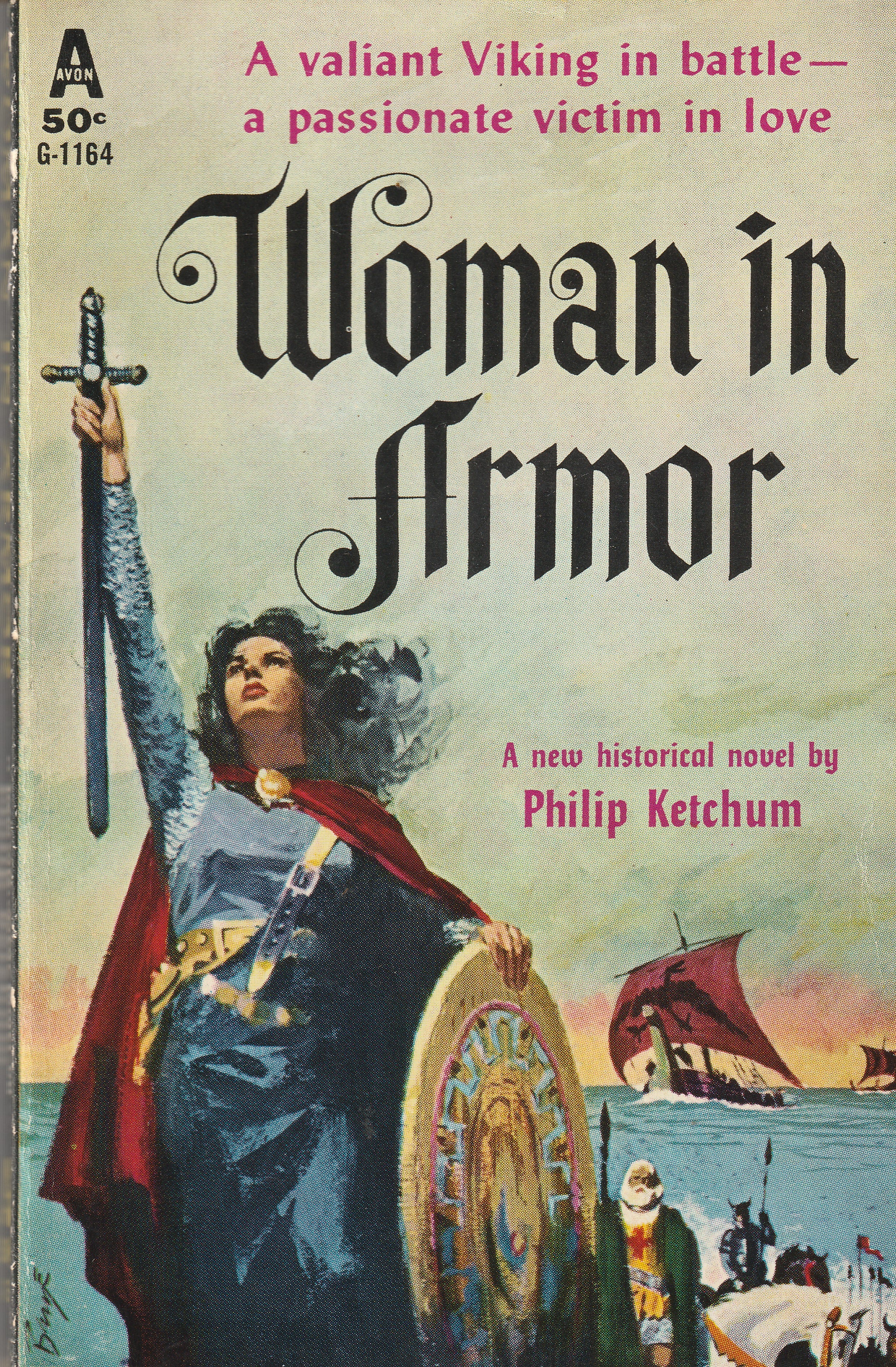
Philip Ketchum was a writer going back to the middle 1930s in the pulp magazines. He wrote adventure, historical, detective, and lots of westerns. Ketchum had a historical series in the pulp magazine Argosy in 1939 with touches of fantasy. The great ax, Bretwalda, is handed down from generation to generation in the Wilton family. Each story dramatized an event in English history such as Viking raids, Norman Conquest, Hundred Years’ War, etc. Ketchum returned to the historical in 1963.
Woman in Armor (Avon Books, 1963) is a tale of Norsemen fighting over land during Viking times. Ivar usurps Ragnar’s earldom while away fighting the Saxons. Ivar’s daughter, Astrid, is thrown into the mix. Oaths to Thor and Odin are noticeably missing in this novel. This novel reads like a converted western with the setting changed from Montana to Norway. Still, there is some guerrilla warfare and sword fights
.
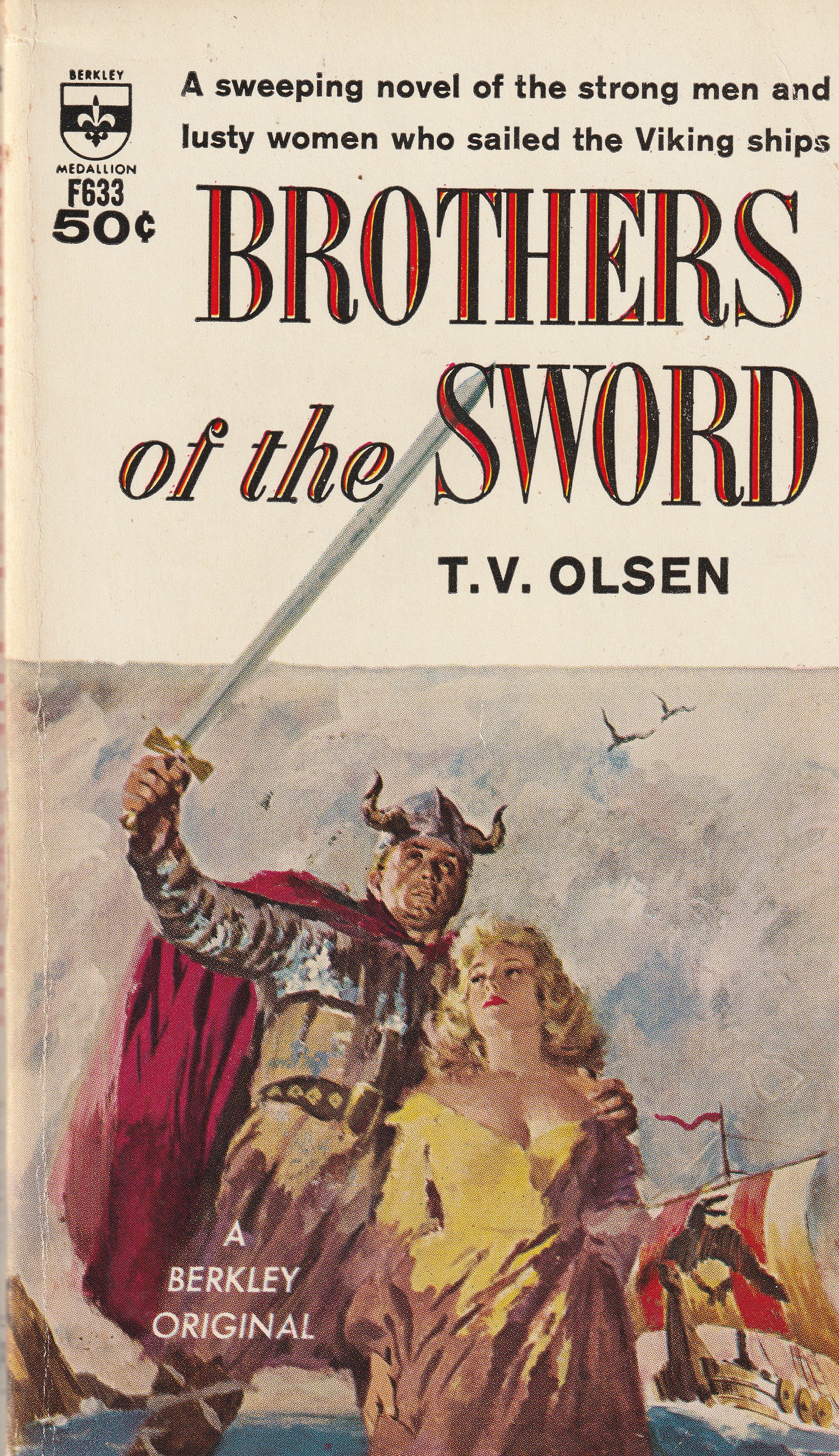
Theodore V. Olsen was a writer from Wisconsin. He started in the western pulp magazines in the early 1950s at a young age. He was a friend of August Derleth and had hopes of making his mark in the horror field. The Stalking Moon is a well-known western novel made into a movie. It works as a thriller as much as a western with the Apache warrior and former Army scout in a game of cat and mouse. Olsen’s attempt at writing in the horror field was a case of bad timing as horror was at a low point. He had a historical, Brothers of the Sword in 1962 (Berkley Medallion). This novel is also set in Norway at the beginning of the 11th Century. Tor and Einar, two brothers who are thralls. They kill Guttorne Ironbeard and flee to Greenland. There is a blood-curdling sword duel and a battle with Eskimos. The novel is out of the ordinary and deserves reprint status. Olsen’s westerns have the same sort of personal vendetta present as in Brothers of the Sword.
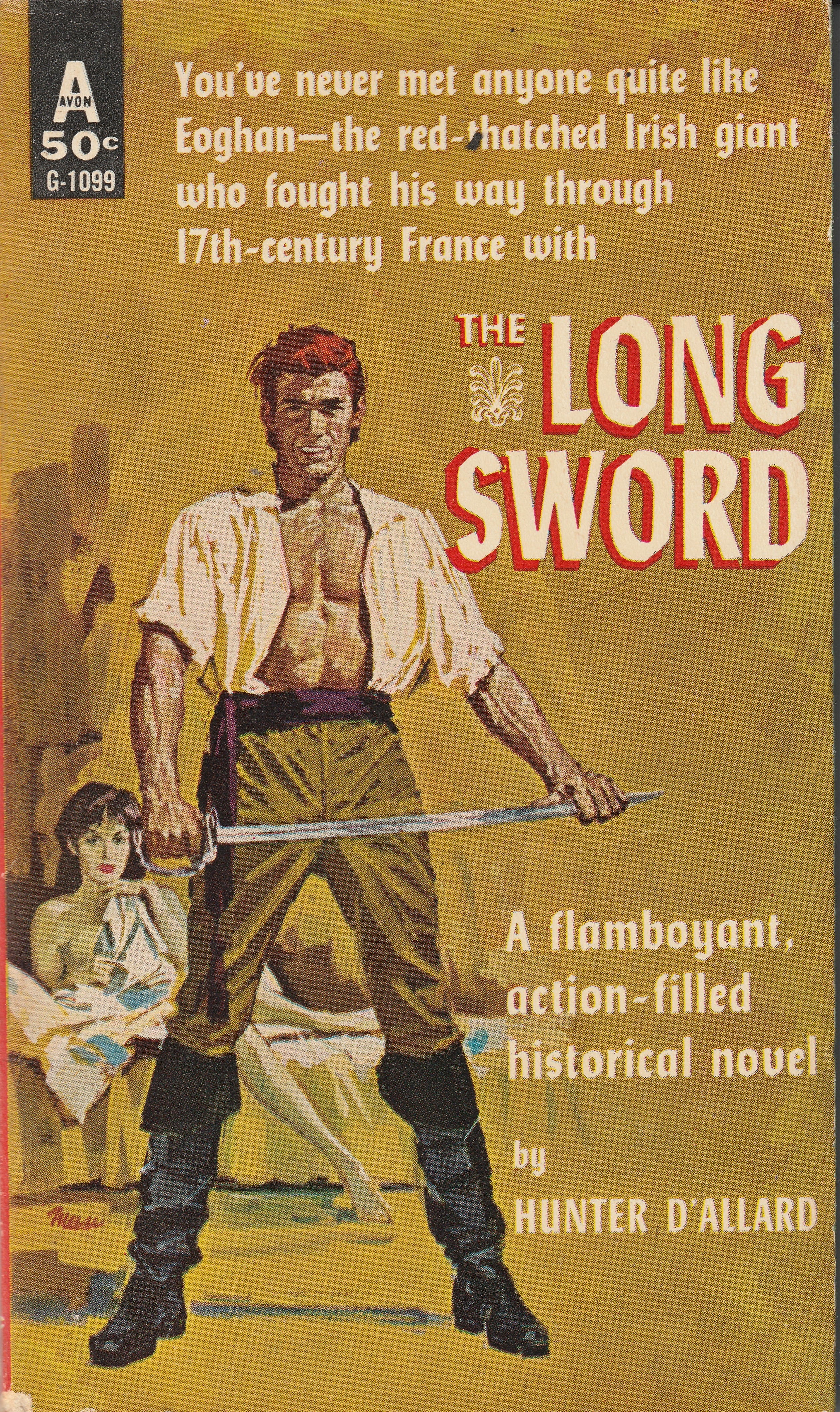
Hunter D’Allard is a pseudonym by pulp writer, W. T. Ballard. Ballard was well known for detective stories in the 1930s and 40s including the legendary magazine Black Mask. He moved into the western field in the late 1940s eventually having stories in slick magazine Saturday Evening Post and Collier’s. He wrote paperback westerns as Todhunter Ballard. The Long Sword (1962) is set in 17th Century France in the time of Cardinal Richelieu. Eoghan Fitzmaurice of Tyrell and his brother are on the run after Eoghan rescues his brother from the Tower of London. They get caught up in the aftermath of Montmortain’s rebellion. This novel is not so much of a transplanted western as Ballard dipping into his hard-boiled urban intrigue
.
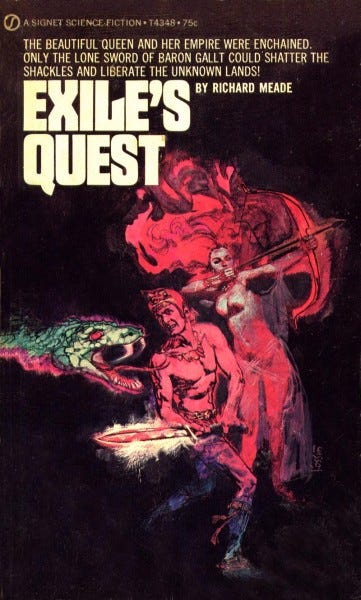
Ben Haas wrote mostly under pseudonyms saving his name for what he considered more “literary” works. He wrote westerns, spy novels, the wonderful “Fargo” series as John Benteen, and three sword-and-sorcery novels.
Sword of Morning Star (1969) was under the Richard Meade pseudonym. The world appears to be Europe in the future after some sort of catastrophic had sent civilization back to medieval technology. The story might be what Karl Edward Wagner called “Desmond Killstar,” but it works. Exile’s Quest is set in the same world as Sword of Morning Star. It is a sort of sword and sorcery Dirty Dozen.
Haas wrote one more sword-and-sorcery novel, Quest of the Dark Lady under the Quinn Reade pseudonym. Quest is more post-apocalyptic barbarism, but Haas again maintains the integrity and a fair amount of sincerity, which carries this novel through. These are recommended fun novels. Spend a summer night or rainy afternoon reading them
.
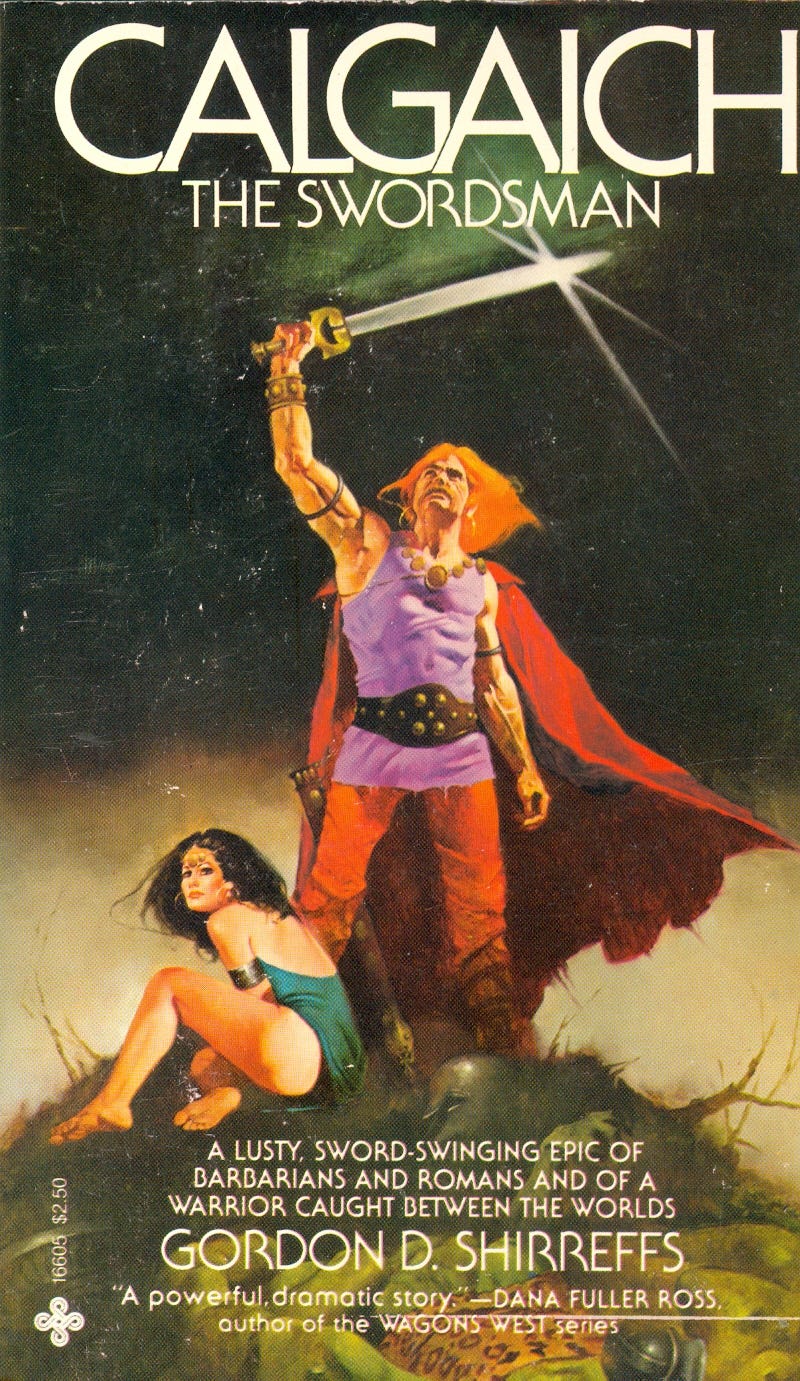
Over the years, I have picked up copies of Gordon D. Shirreffs’ Calgaich the Swordsman and given them away as gifts. Everyone loves this novel when I introduce them to it. Calgaich is about a Celtic Briton warrior fighting the Romans. There are Picts, gladiator fights in the arena, lots of gratuitous violence, and pretty good historical detail. James Reasoner found out the original title for this book was The Celtic Blade and that the book sat on Playboy’s shelf for a few years until they got around to publishing it in 1980. Shirreffs was keen to write a sequel but Playboy screwed the pooch. A shame we never got that sequel.
Reading Calgaich the Swordsman, you get the distinct impression that Shirreffs was very familiar with Robert E. Howard and decided to write something Howard would approve of. Shirreff’s is no slavish imitator, the book is in his own voice and better for it.
Louis L’Amour supposedly wrote The Walking Drum earlier. The Louis L’Amour Companion states the book was written in 1970. Beau L’Amour said his father wrote it around 1961. Bantam Books published The Walking Drum in 1984. The book is a series of adventures of Mathurin Kerbouchard in 12th Century Europe and the Middle-East. The historical anachronisms fly fast and furious. Written in the first person, Kerbouchard states he is a pagan and had Druid training. In the 12th Century, an outright pagan in Brittany would have been burned at the stake. The Druids were long gone as was their learning. Escaping from enemies, he naively attempts to buy passage on a corsair ship where the captain promptly imprisons him to the galley oars. Within a couple of pages, Kerbouchard goes from being an unworldly teenager to Cugel the Clever tricking the captain. L’Amour is famous for lack of time consideration in novels such as Sitka where he compresses events over twenty years into seeming like a year or two.
The ship ends up in Moorish Spain. L’Amour stops the story often to engage in info-dump, often on the superiority of the Moslems to Christian Europe. L’Amour fell victim to the idea of the “Dark Ages,” which was not so dark. L’Amour has no descriptions; his Moorish Spain could as easily be the southwest United States. He also didn’t research his weapons very well as his Moors are using scimitars instead of straight swords. The classic scimitar was a few centuries in the future. Some of the action scenes are clumsy in execution. There is a storming of a castle that catches the reader’s attention but that is the exception in this novel. The story goes from Brittany to Spain to France to Kiev to Constantinople to Mt. Alamut of the Assassins. He rescues his father who is imprisoned there using gunpowder. This wouldn’t have been a bad novel with some judicious cutting and rewrites of scenes. The episodic nature of the novel would have worked as a series of novelettes or novellas for a magazine. The Walking Drum is a novel in need of an editor.
The Walking Drum uses the plot of a young man growing to adulthood through a series of adventures. He used the idea in the novel, To Tame a Land. The Walking Drum does read like a novice effort in a new genre for L’Amour. Subsequent historical novels Sackett’s Land and Fair Blows the Wind are leaner in execution and lack the exposition.
The historical and sword-and-sorcery novels by western authors are an interesting genre niche. There were not many of them. Brothers of the Sword and Calgaich the Swordsman have that extra bit of detail giving authenticity to the narrative. Vividly drawn characters acting out strong situations of conflict is a recurring theme whether the writer sets his story in medieval Europe or late 19th Century American West.
I reread The Walking Drum every few years. Yes it’s a bit of a mess, but I always chalked it up more to the braggadocio of the main character than anything else. Because of its setting in multiple geographical vignettes, the reader feels brought along on the journey along with the character.
This essay was sooooo good!
Going to have to check each of these stories out!