


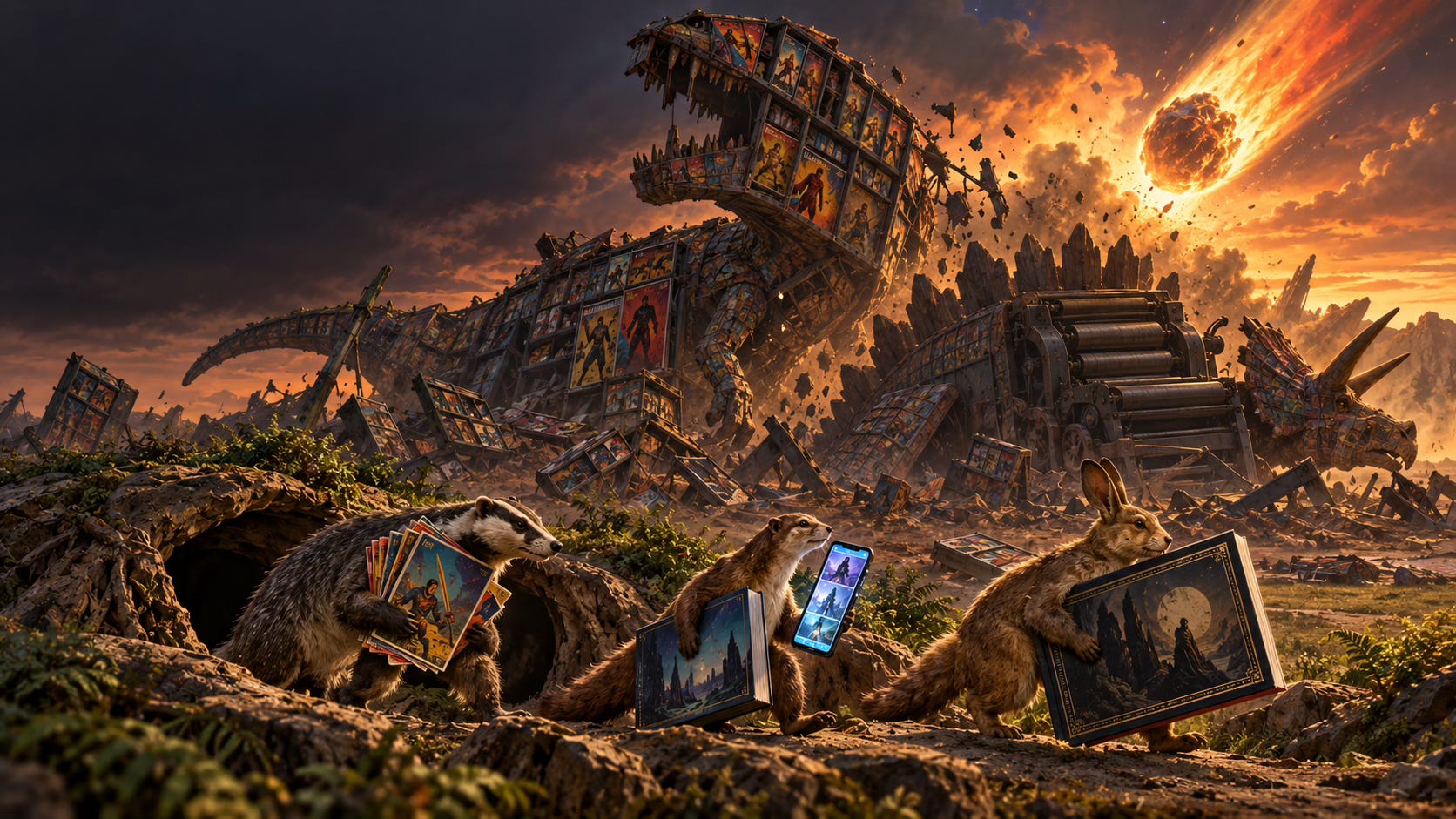
About ten years ago, traditional comic books collapsed. It was not a sudden catastrophe.
That rocket train had been headed downhill for quite a while. But about a decade ago, thanks to a number of different factors, it finally ran out of track while simultaneously flying off a cliff.
DC and Marvel had effectively bottomless pockets thanks to corporate overlords that viewed their consistent annual losses as basically a rounding error, it was more important to Disney and Warner Media to keep them publishing as legitimacy engines than as a for profit enterprise. Corporate behemoths could keep the presses rolling but couldn’t make anyone read them. When Covid-19 rolled into town the comics stores closed and many never reopened, especially after Diamond Distributors ground to a halt. This was the low water mark.
In 1985 there were around 4,000 comic book shops (no, I can’t get more accurate than that). By comic book shop I mean what we would view as a traditional, direct-market non-returnable comic books on a new release wall, with long boxes in the back. And these things being the primary source of income.
There were still about 2,000 comic-book shops in America when 2020 began, but even that number disguised how far the traditional business had already fallen. A lot of those stores weren’t really comic-book stores in the old sense I just described. They were collectors’ shops.
The long boxes had always been there, but increasingly the back issues, slabs, graphic novels, manga, trading cards, games, expensive toys and every other form of geek memorabilia were what kept the lights on. Wednesday’s new comics were still on the racks, but they were now one product line among many, and not the most profitable. The Direct Market hadn’t merely lost stores. Many of the stores that survived had already diversified away from the product the Direct Market had been created to sell.
However, the comic book wasn’t dead. People have enjoyed stories through sequential arts for at least 68,000 years.
About the time Marvel editor Heather Antos’s “Make Mine Milkshake” post kicked the applecart. Several comics creators who had found themselves out of work started banding together to start their own companies.
And some of them actually managed to stay in business.
In this article I’m going to exclude webtoons publishing houses like Arkhaven and focus on the top three (basically) traditional comic book publishers.
All three are very different from each other but all three do have similarities.
There are almost no superhero titles. The American superhero is fundamentally a consensus myth being published into a post-consensus society. When we mostly agreed on what our story was and what the story of the external threat was, superheroes could thrive. At least in America. This is no longer the case which led to the rather stomach churning deconstructed superhero cliche. And to be clear, it is no longer a trope, it is definitely a cliche.
They sell genres rather than universes. Horror, fantasy, SF, crime, adventure and dark comedy dominate. Marvel/DC traditionally sell Marvel and DC first—the shared universe itself is part of the product. These companies sell Barbaric, Dungeon Crawler Carl, Somna, etc. You don’t need to know what happened in seventeen other titles.
They favor finite stories. Miniseries, limited series, graphic novels and defined arcs are normal. They’re not trying to keep Detective Comics publishing until issue #2,000. That drastically lowers the barrier to entry: Issue #1 actually means Issue #1.
The floppy is no longer the final product. This may be the most important commonality. A single issue can establish an audience and generate cash, but the durable product is often the trade paperback, hardcover or premium collected edition. They’re much closer to book publishers that serialize than old comics companies dependent upon an endless stream of 32-page periodicals.
They don’t depend upon Diamond. Mad Cave, Vault and DSTLRY all built or rebuilt distribution around alternatives, particularly Lunar and major book distributors. The comic shop remains important, but no single distributor and no single retail channel gets to hold the entire company hostage.
Bookstores matter. All three have serious book-market distribution. That means Amazon, Barnes & Noble, libraries, independent bookstores and online book retailers aren’t afterthoughts. This is another major break from the old Direct Market mentality.
They treat creators as assets rather than interchangeable labor. The degree varies considerably—DSTLRY takes this furthest—but creator ownership, royalties, participation and prominent creator branding recur across the three. DSTLRY practically sells books on who made them. Aethon/Vault often starts with an author who already owns an audience.
They are willing to import audiences from outside comics. This is strongest with Aethon/Vault, obviously: LitRPG, Kindle, Audible, Royal Road/Webtoon audiences become potential comics customers. But Mad Cave does it through manga, YA, children’s books and licenses, while DSTLRY does it partly through established creator followings. None assumes that tomorrow’s customer must already be visiting a comic shop every Wednesday.
They keep their bets relatively small. Instead of launching twelve interconnected monthly titles and praying that a universe catches on, they can test a limited series, graphic novel, license or adaptation. Failure doesn’t necessarily poison an entire publishing line.
With these things noted we’ll start with Number One:
Mad Cave Studios
Mad Cave put out its shingle in 2014. They’re Miami based and started out doing what small comic-book publishers have traditionally done: creating original comic books and hoping somebody noticed.
Somebody eventually did.
What makes Mad Cave interesting today isn’t any one title (I’m looking at you DC which at this point should be changed to Batman Comics). Mad Cave has gradually constructed something that looks shockingly like an actual publishing house rather than a company desperately waiting for one character to become Batman.
They’ve divided their market by readership rather than by fictional universe. Maverick handles Young Adult comics. Papercutz, which Mad Cave acquired in 2022, handles children and middle-grade books. Nakama Press handles manga and other international comics, including Japanese, French and Brazilian material. The mothership publishes everything from horror and fantasy to crime, science fiction and adventure.
Papercutz has become particularly interesting. They’ve landed Disney children’s properties and in 2026 published an original Mandalorian and Grogu comic. What this says about the kind of faith Disney has in Marvel Comics… Would appear to be well placed.
Then there is Mad Cave’s major strategy of legacy genre IP rehabilitation.
Dick Tracy, Flash Gordon, Gatchaman, The Last Starfighter, Escape from New York and Speed Racer aren’t dead properties by any means, but nobody would accuse them of being red hot either. They come with something extremely valuable to a small publisher that knows it’s small: names people already recognize and fanbases somebody else paid to create decades ago. It’s not a big market but it is a pre-existing one.
This plan only works if you don’t piss those people off.
Mad Cave appears to understand that part too. Their approach isn’t museum-piece fidelity, but it doesn’t seem interested in playing the now-exhausted game of drag an old IP out of cold storage so you can have it explained how everything you loved about it is now racist, sexist and homophobic. They aren’t doing that. Flash Gordon is still Flash Gordon. Gatchaman is still Gatchaman. Their Last Starfighter is a direct continuation of the movie being developed with original screenwriter Jonathan Betuel.
This is harder than it sounds. Flash Gordon in particular requires a publisher capable of looking at rocket ships, bird-men, ray guns and Ming the Merciless without either becoming embarrassed or turning the whole thing into a joke. Mad Cave’s solution has basically been to modernize the execution while taking the ridiculous premise seriously.
More importantly, Mad Cave doesn’t have to turn The Last Starfighter into Star Wars. It only has to sell enough new adventures of Alex, Grig and Centauri to people like me who still get that movie’s opening score going through their heads whenever they think about The Last Starfighter for more than one minute.
A profitable niche is still profitable if you handle it right.
That’s Mad Cave’s business model in miniature. One niche doesn’t have to support the company. Stack enough niches together and suddenly you have a publishing house. They’ve got a YA line of comics with Maverick. Kids comics with Papercutz, and Nakama for Manga, French and Brazilian imports.
Crucially, Mad Cave doesn’t expect all of those customers to shop in the same place. Comic shops remain important, but the company also sells through the conventional book trade. A children’s Smurfs book, a Flash Gordon comic and a manga release don’t have to reach the reader through the same store.
This sounds obvious but it sure as hell wasn’t obvious to an American comic-book industry that spent decades building itself around getting a nonreturnable 32-page pamphlet onto the Wednesday rack of Fourth Dimension of the Starrealm Comics and Collectables.
Of the three companies I’m looking at, Mad Cave is consequently the least revolutionary. It is trying to prove that the traditional American comic-book publisher can still work. You just have to build one for the market that actually exists.
Vault Comics
Our number two wouldn’t have been on this list at the start of last year.
Things changed.
Vault Comcs has been around since 2016 and had built themselves a respectable niche, particularly in science fiction and fantasy. Their biggest homegrown title was Barbaric, which I rather liked. It’s about an almost completely amoral barbarian named Owen who has been cursed to do good by a talking axe named... Axe who is blood thirsty and has a serious drinking problem. It’s that kind of comic. And it is NOT for kids. Most of their titles aren’t, Vault are kind of the spiritual successor to DC’s old Vertigo line. Although Vault does have a kids’ line called Wonderbound.
Regardless, Vault would have been on most people’s “rising stars” list but not Top Ten list, let alone land at number 2. But in May 2025 Aethon Books acquired a majority stake in Vault and that changed the equation.
Aethon isn’t a comic book publisher, it came out of the enormous parallel universe of Kindle, Audible, indie science fiction with a heavy emphasis on LitRPG and progression fantasy. Aethon publishes He Who Fights With Monsters, Defiance of the Fall, The Primal Hunter and a small army of other books with big digital readerships. That means Aethon arrived at the comic-book problem from exactly the opposite direction.
Marvel and DC traditionally starts with a comic and hopes that someday enough people like the character to turn it into something else. Aethon already has the “something else.” Their problem is figuring out how many different products they can manufacture from an audience they already own.
Take Dungeon Crawler Carl. Matt Dinniman’s series was already a monster when Aethon adapted it into a vertical-scroll comic for WEBTOON, deliberately using the visual vocabulary of Korean webtoons. Honestly, it’s the smart move. Manga is sooooo Gen X, says the Gen Xer. But Gen Z and Alpha are notorious Korea-boos.
Now Vault is taking that webtoon, rebuilding the vertical artwork for pages, and selling it as a physical graphic novel. They are doing the same for their toons of He Who Fights With Monsters, Defiance of the Fall, The Primal Hunter.
Novel reader becomes audiobook listener becomes webtoon reader becomes graphic-novel customer. The comic isn’t the beginning of the IP anymore. It’s another format.
Aethon isn’t doing this with one lucky title. They’re applying the same process to their growing catalog of LitRPG and progression-fantasy properties.
And the Korean thing is more important than you think. Japanese manga already won its war for the American youth market. Anime and manga aren’t strange underground imports anymore; they’re mainstream entertainment. Korean webtoons brought a newer visual language designed from the beginning for the device young readers actually carry around all day.
The really clever part is that LitRPG already fits that language. Levels, skills, increasingly powerful enemies, constant progression and endless serialization are as natural to the Korean webtoon format as capes and cowels were to the American comic book.
Vault gives Aethon the piece of the machine it didn’t have: an established American comics publisher capable of turning all of this digital material into physical books and putting those books into comic shops and bookstores.
And the traffic runs in both directions. Aethon and Vault have also launched a print imprint bringing Aethon’s successful ebook and audiobook novels into conventional retail bookstores. The catalog feeding that operation had already sold more than twenty million copies digitally before Aethon/Vault started putting it on retail shelves.
Aethon/Vault isn’t really betting on the future of the floppy. It isn’t betting on the future of the graphic novel. It isn’t even betting exclusively on the future of the webtoon. It’s betting on IP with an audience, and treating prose, audio, webtoon, comic and graphic novel as different doors through which that audience can enter.
Of the three publishers in this article, Aethon/Vault may consequently be the one that has learned the most radical lesson from the collapse of the old comic-book business:
The future comic-book reader doesn’t come from reading comic books.
DSTLRY
Finally we have DSTLRY, which has chosen almost the opposite strategy from Aethon.
If Aethon is increasingly indifferent to what physical form a story takes, DSTLRY cares about the physical object a great deal. DSTLRY was founded in 2023 by former ComiXology executives David Steinberger and Chip Mosher. That background makes what they decided to do incredibly ironic. Two guys who helped build digital comics concluded that the physical comic book needed to become more physical.
DSTLRY publishes oversized, prestige-format comics with high-end production, generally built around short runs by established creators. The obvious comparison is the French album comic book, although DSTLRY still retains American periodical serialization. The basic proposition is that if you’re going to ask somebody to leave the house, and buy ink printed on dead trees in the Year of Our Lord 2026, you should probably give him something that feels worth owning.
And DSTLRY isn’t embarrassed to be a collector’s item. Steinberger has complained that the comics industry became almost ashamed of collectibility. DSTLRY deliberately produces limited print runs, variant covers and premium editions and treats the physical comic as an artifact rather than disposable monthly reading material. This also explains their creator strategy.
DSTLRY came out of the gate with a ridiculous collection of established comic-book talent. Their founding creators don’t merely receive royalties. They own equity in DSTLRY itself, while creators retain ownership of their work.
That gives DSTLRY something the other two companies don’t have. Mad Cave is primarily building a publisher brand. Aethon is primarily building an IP-and-audience machine.
But DSTLRY is building around creator brands.
A James Tynion reader doesn’t necessarily care whether his next book shares a universe with the previous one. DSTLRY is betting that the name James Tynion on an exceptionally nice comic is enough of a universe.
And it has produced some very pretty books.
Somna, by Becky Cloonan and Tula Lotay, won the Eisner for Best New Series in DSTLRY’s first full year of publishing. Other books like The Devil’s Cut, Gone, Spectators and White Boat established fairly quickly what a DSTLRY book was supposed to look and feel like.
There is, however, a gigantic asterisk next to DSTLRY. They’re very young, and they have already been punched in the mouth hard enough to loosen teeth.
Diamond’s 2025 bankruptcy badly disrupted their publishing schedule. DSTLRY switched distribution to Penguin Random House, which now handles both comic shops and the wider book market, but the transition contributed to release gaps. In January 2026 the company announced a publishing pause. It resumed releases in March, to the point of having to tell customers to go back to their comic shops and re-order books whose previous orders had been cancelled.
That is very shaky ground to be standing on especially for such a young company.
DSTLRY is attempting the model that remains most dependent upon people who really, really like comic books as physical objects. That gives it a smaller potential audience than Aethon’s phone-reading hordes, but potentially a customer willing to spend considerably more money per book. It’s trying to sell fewer things with higher perceived value. This does mean they are abandoning the youth market for the original comic book nerds of the 80’s Boom because they can finally afford the top shelf stuff now.
Whether that becomes a durable publishing model is a very open question. Of the three companies here, DSTLRY is the one I’d be least willing to put my money on. That said, the experiment itself is fascinating.
If we must charge more, then fine, charge more. But give the customer more for his money.
In Conclusion:
Of these three publishers none of them thinks “save the American comic-book industry” means restoring 1989. None is trying to get America back to 4,000 stores full of 32-page monthly pamphlets.
I am certain at least one of them is going to fail. Maybe at most two.
But I don’t think it will be all
Discuss in the Comments Below
The Direct Market was dying in the late 90s, but collectors and fringe pop culture enjoyers have had it on life support for decades. The Direct Market has much of this blame on their own heads. No feeder chains for new readers to access the works and rigid adherence to doing what the Big Two have told them to do regarding business operations. The outcome was a foregone conclusion.
Narrative and sequential art will find a new way. It always does.
Spinner racks in normal stores was the gateway for most of the older generation. Going to an actual store that specialized in comic books was the exception. Not the rule. Would spinner racks work today? I doubt it. Paperbacks have also disappeared. The comic books may go the way of the pulps. Warner Brothers hasn't known what to do with their superheroes - unless they're creating an animated cartoon. The MCU kept brick & mortar comic book stores on life support but now that the MCU itself has exhausted itself . . . it doesn't bode well.