

The Dark Herald Recommends - Spider Noir

You. Can. NOT. Fix. Her.
That is the first thing you have to know about the noir femme fatale.
Sure when she’s looking at you with eyes full of tears it all“Tell me I can be saved.” Or “Tell me I’m not all bad.”
But that’s what she wants from the mark, and if the dame to die for is a proper femme fatale, there’s an element of truth to it. But never forget, she wants the mark to feel that. And you, the audience member, are the mark. You know she’s trouble but you’re still too intrigued to say no. That’s why she still works whether she’s sauntering into Phillip Marlowe’s office with an eye full of crocodile tears or Harry Dreden’s.
If the storyteller is doing her right, she’s not the secret feminist hero, or a psychopathic super villain, and she is definitely not the real victim. What she is, is human but one who uses all of her assets to get whatever she wants. She’s a calculator who enjoys the game she’s playing. The Lady in a Red Dress is an apex predator who happens to be beautiful, charming, and self-aware enough to weaponize it all. She operates in that narrow psychological band where the dark triad traits (especially Machiavellianism and a high dose of psychopathy) give her the ruthlessness to scheme, seduce, betray, and if needed, to kill without remorse… But she retains just enough of her humanity… Her affective empathy and ego to crave absolution. Forgiveness without accountability is the ideal outcome for her.
So, when Cat Hardy tells the gumshoe she’s played for a sap at the end of Spider Noir, “I want you to know in another time and another place, things could have been different between us,” She means it, but she also has an ulterior motive for saying it because she always has an ulterior motive for everything.
And Ben Reilly sees right through it, “It’s one thing to play a guy for chump. It’s another to try and keep him on the hook afterward.” Because that is exactly what she wanted; forgiveness, but more importantly, no consequences.
Spider Noir knows what it’s trying to be. There are compromises imposed by a number of small things and I won’t dismiss or ignore them, But the important thing is, it succeeds in what it’s attempting.
Spider Noir works because it understands noir. The old mobster, the sarcastic secretary, and the Femme Fatale prove it.
Sony hasn’t had the best track record with Spider-man spin-offs for every success like Into the Spiderverse there three failures like Madam Web. But I guess they were over due for another win because Spider Noir is a good show. It’s not a great show or revolutionary one. It’s not at all ground breaking but it didn’t have to be to succeed.
This is how far we’ve fallen. Baseline competence is extraordinary enough to be entertaining.
This isn’t a Spiderman show, it’s a film-noir detective show with some spiderman elements, unlike Madam Web for an outstanding example, there are enough Spider Man elements that it’s recognizable as a Spider Man property.
Spider Man Noir was one of the last creations of a fully independent Marvel, the first issue came out in 2008. It was a lot more gritty than most people would think because most people never read it. They first became familiar with him in Into the Spider-verse, a much more comical take on the character but he was voiced by Nicholas Cage and Nick took a shine to him. Cage had tried to play Harry Dresden years ago but the project completely fell apart, I think this super powered noir detective scratched an old itch for him.
And let’s be clear, this character, Ben Reilly, is a lot closer to Phillip Marlowe than he is Peter Parker. Don’t get me wrongThe bones of Peter Parker are still there, but this is a Peter who survived the trenches, buried friends, and spent a decade watching the city rot around him. A Peter who had friends betray him. He lost the woman he loved and there was no MJ hanging around to pick up the pieces.
This story has all the elements of Film Noir, if Ben didn’t have Spider powers, the narrative could still mostly function.
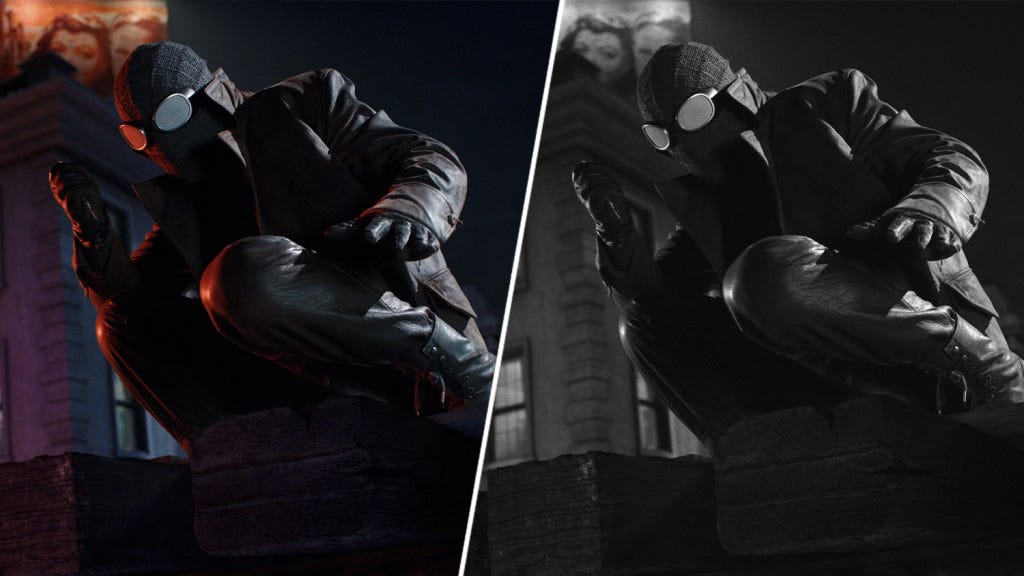
However, the production itself is not classic Hollywood noir. First, you are offered two ways watch it, monochrome and stone wash. Go with the Black and White if you decide to see this, it sets the tone properly in a way the colorized version fails to. But keep in mind it’s not a genuine black and white production, it’s a lot closer to Sin City.
This movie was clearly shot on a volume stage, the blocking of the actors gives it away every time. They are usually either standing or sitting. If they are running it’s for very, very short distances.
This claustrophobia kills something like Obi-Wan where it’s supposed to be all about the action but Film Noir has always thrived in confined spaces. Offices and Ally ways. Newspaper rooms and night clubs. The physical restriction is part of the production value. It creates focus, and it’s used effectively here.
That said, it’s not all good. The first time you see Nick Cage run down an ally you know without question you’re seeing a man in his sixties running. He is simply too old for the part, sad but true.
And while the confinement helps the story, in the back of my mind I kept thinking, I know this was shot on a Volume stage.
A badly wounded detective is kind of a standard trope. His fiancee was a Gwen Stacy-esque character. She was murdered by having her wrist hand cuffed to a steering wheel and driven off a peer. And the problem is that he’s right there and realistically given his power level is going to able to rescue her. In the back of your mind you keep asking, Okay, why did you let her drown - just so your trauma will happen?
The show asks us to believe a tragedy that Spider-Man should have been able to prevent.
Which is ultimately the early setup of the show. Ben is a hero who is refusing the call because he’s a wounded hero. That’s what the show wants and it’s valid for a noir detective but in improving the Death of Gwen, they create a character that I don’t quite believe in.
Sidenote: Gwen is alive in the Spider Man Noir comic book continuity, and Spider Man is named Peter Parker. My guess is that Disney strongly requested the Peter Parker name not be used for whatever odd Disney reason.
One thing that I did really like about this season is that the story actually had a conclusion. It’s been a while since I’ve seen that in a TV show. Normally, they end in a cliffhanger and these days cliffhangers suck. Audiences are sick of them.
It takes three years between seasons, so the momentum is completely gone and half the time the show gets canceled. The other half of the time the writers sweep it under the rug by answering with a mystery box or just hand wave it away. Remember when Sherlock jumped off a building for no reason at the end of season 2 and the start of season 3 the show made fun of the fan theories for a half hour before refusing to answer at all.
Spider Noir has an actual ending and it’s reasonably satisfying.
You do get an answer to the mystery which is never a guarantee in Film Noir because the investigation is what’s important.
Spider Noir is a pleasant surprise in Sony’s spotty history of Spider-Man spin-offs, a show that knows exactly what it wants to be and largely delivers on it. By leaning into film noir conventions rather than superhero spectacle, it carves out a distinct identity, and the choice to watch in black and white is the right one. Nicolas Cage brings a world-weary Philip Marlowe energy to Ben Reilly that mostly works, even if his age occasionally breaks the illusion during the show’s more physical moments.
The production has real limitations. The volume stage shooting is visible to any attentive viewer, the blocking is stiff, and the backstory surrounding the death of Ben’s fiancée strains credibility given his power set. But noir has always thrived in confined spaces and moral ambiguity, and the show uses both to its advantage. The femme fatale in particular is handled with genuine sophistication, Cat Hardy is neither a secret hero nor a cartoon villain, but a fully realized predator who wants forgiveness without consequences, and the show is sharp enough to call her on it.
In an age of mystery boxes, multiverses, and cliffhangers, Spider-Noir does something almost revolutionary: it tells a story, solves the mystery, and rolls the credits as the detective walks off into the night..
The Dark Herald Recommends with Confidence (3.9 / 5)
‘
The girlfriend and I have been enjoying it. We've still got the last episode to watch. I'm a big Spider-Man fan and a noir fan, so this was already firmly in my wheelhouse.
~~Cage had tried to play Harry Dresden years ago but the project completely fell apart,~~
Prime Nic Cage playing Harry Dresden...
Now THERE is a thought...