

Vampire Rules
Part I

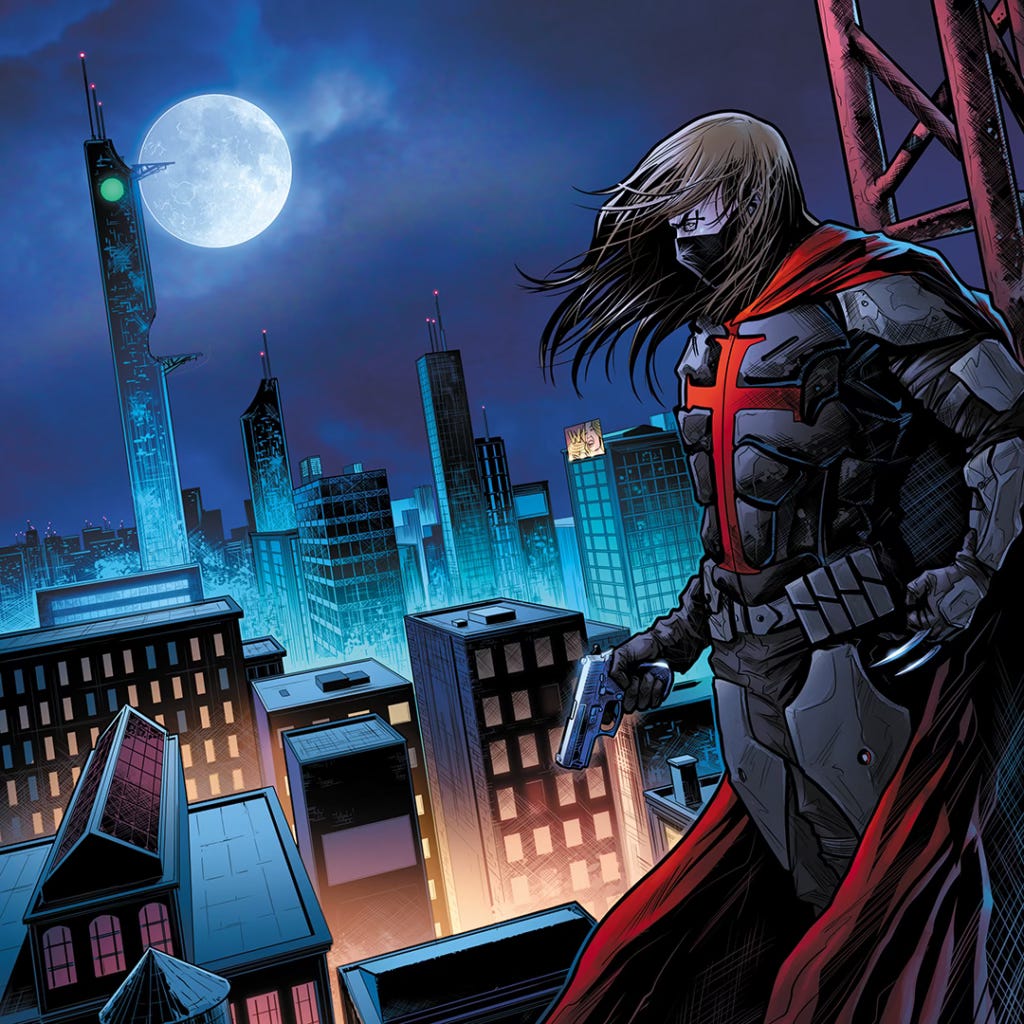
Author’s Note: I went to Spirit Halloween today for the first time this year. Which means the Halloween season has officially started, I guess. I have another piece that I will hopefully tack up tomorrow. It really needs a first thing in the morning editing pass.
Midnight’s War and the Problem of Rules
I am quite convinced that there is no doubt whatever that the events here described really took place, however unbelievable and incomprehensible they might appear at first sight. And I am further convinced that they must always remain to some extent incomprehensible.” – Bram Stoker
I debated calling this piece Vampire Rules Suck.
Nominal good taste won out.
Midnight’s War is the Arkhaven title that currently holds my promiscuous interest in its thrall. This doesn’t look like the usual Blade rip-off at all. I’m rather curious as to what Vox has in store for us.
I want to see what restrictions a professional game designer, a man who creates balanced rules for a living does with a set of rules he’ll have to come up with for Vampires.
The only hard and fast rules for dealing with vampires historically is that there were no rules. None that were in stone anyway. The prescribed method of dealing with them appears to have varied widely from village to village. Hardly surprising, these were peasant myths meant to explain any particular bit of bad luck a backcountry community was having.
The Church and Calmet
The Church doesn’t seem to have been too interested in the matter. Demons, they cared about, peasant monsters, seem to have been viewed as largely superstition. At least until a Benedictine monk named Antoine Augustin Calmet compiled his “Dissertations Upon the Apparitions of Angels, Daemons, and Ghosts, and Concerning the Vampires of Hungary, Bohemia, Moravia, and Silesia” in 1746.
I’m not saying you can’t find Vampire stories before then, obviously, you can, but Calmet’s work was a genuinely scholarly dissertation by a reputable academic that was meant to record these tales as a stringent relation of facts rather than as a campfire tale meant to entertain.
Brother Calmet related and recorded accounts from the peasantry about tales of the dead who, “come back to earth, talk, walk, infest villages, ill use both men and beasts, suck the blood of their near relations, destroy their health, and finally cause their death.” These walking dead, he wrote, “are called by the name of vampires.”
The Case of Arnold Paole
“One of the most famous cases in Calmet’s collection came from Austrian army surgeon Johann Flückinger. The doctor described the case of Arnold Paole, a soldier and alleged vampire victim from a Serbian village. To banish vestiges of the vampire, Paole ate dirt from its grave and smeared himself with its blood. He returned to his life as a farmer, but soon after died in a hay wagon accident.
About a month after his death, villagers claimed that Paole had risen from the dead and killed several people. Animals and livestock were also attacked and drained of blood.
Suspecting vampirism, the villagers exhumed Paole’s body. They found it intact, the nails had grown, and he had a light beard. Fresh blood covered the inside of the coffin. The villagers “drove a stake through his heart, whereby he gave an audible groan and bled copiously.” The bodies of other villagers, thought to have been also transformed into vampires, were also dug up and ritually defiled to prevent the spread of the great contagion of Vampirism.”
Notes From the Field
The Deadman’s Groan is a known phenomenon. I’ve seen it myself. Someone dies with air in their thoracic cavity. The esophagus (which is muscle-powered), collapses, trapping the air inside of it. A Marine walking by nudges it, the air escapes the thoracic cavity, vibrating the slack vocal cords, resulting in the Deadman’s Groan and possibly some panic fire if the Marine who nudged him is the new guy. Everybody else knows what it sounds like.
The preservation is explained by interring the body in the cold, damp ground, resulting in saponification. In simplest terms, the cold, wet corpse’s fat turns into a thin layer of soap that protects the body from decomposition. Hair and fingernails do NOT continue to grow after death, but dehydration will retract with the mortified flesh, leaving exposed nails, facial stubble, and an illusion of post-mortem growth.
As I said, there is plenty of archeological evidence that European peasants were worried about Vampirism long before Calmet’s work was published. Digs sites of medieval graves have found skeletal remains with iron bars driven through the rib cage postmortem, skulls smashed, and skulls that have had bricks shoved in the mouth to prevent the dead from eating their way out of their graves. Historically speaking, accounts of Vampires always seem to have been on the rise whenever the plague was in town.
Vampires In New England
More surprising was seeing American farmers doing this kind of stuff in the 19th century.
For whatever reason, New England was rather given to Vampire panics throughout the 18th and 19th centuries whenever Cholera and TB were making the rounds.
In 1891, the Brown family from Exeter, Rhode Island, had been devastated by “Consumption.” Mercy’s mother and elder sister had died from the disease several years before. Her brother had been afflicted at the time, but went to Colorado, and it went into remission there. However, in 1891, both Mercy and her brother came down with it. Mercy died first. The Brown family’s (all two of them at this point) neighbors, concerned for their own health, came to George Brown, the father, demanding that his womenfolk be exhumed and examined for signs of Vampirism. He gave in to his neighbors’ frantic pressure. His wife and eldest daughter were decomposed, but Mercy had died in winter and likely been freeze-dried into preservation by the dry winter air. Her heart and liver were removed, burned, then mixed into a potion to be given to Mercy’s brother. It didn’t help (big surprise) he died two months later, leaving George Brown all alone in the world and facing quite a bit of wrath from the scientific community for having let his daughter’s body be desecrated in the name of pagan superstition. It should be noted that Mycobacterium Tuberculosis had been positively identified in 1881 but there wouldn’t be a treatment for it until the 1940s
There had been a reporter present, and that story had legs. It was in a paper in London that a young stage manager and occult fetishist named Bram Stoker read about it.
From Stoker to Murnau
Now, it wouldn’t be accurate to say that he invented vampire fiction. Vampire short stories were already popular. Carmilla was the most famous before Dracula. Victorian authors’ biggest innovation was in making their blood-sucking antagonist sapient; the “villagers” had always seemed to regard Vampires as mindless, even if capable of speech. In giving the undead a living mind in a soulless body, something new was created in fiction.
And whether Stoker had meant to do so or not, he also introduced a sexual component. Women could not say no to Dracula, and more than a few of his female readers didn’t really want to. There was a fascination with blood as an arousal trigger. I don’t get it personally, but I obviously can’t deny the existence of the fetish.
By any reasonable standard, Bram Stoker was an oddity. The breadth of the 19th-century Spiritualist movement is drastically underestimated today. It was pervasive in the middle to lower upper classes. The desire for secret knowledge could be found in organizations that were everywhere, from London to Omaha, Nebraska. Stoker himself was in the spiritualist Society of the Golden Dawn, whose members ranged from Sax Rohmer and Oscar Wilde to Aleister Crowley, and even Arthur Conan Doyle. Traces of the spiritualist movement aren’t hard to find in Dracula.
“I am here to do your bidding, Master. I am your slave, and you will reward me, for I shall be faithful. I have worshipped you long and afar off. Now that you are near, I await your commands, and you will not pass me by, will you, dear Master, in your distribution of good things?”
My own opinion is that Spiritualism was one giant 19th-century mystery box but a pretty dangerous one to play in.
Vampirism’s next major influencer was the German director Friedrich Wilhelm Murnau, an even odder duck than Stoker.
Murnau was as shaped by Nietzsche as he was by Shakespeare. An art student at Heidelberg, he became an infantry Captain in the German army, he switched to the air corps, and survived several crashes, but not without injury. His kidneys were so damaged that he couldn’t drink alcohol for the rest of his life. Although he more than made up for that with his Morphine addiction, given the severity of his back injuries this may have been unavoidable.
The Morphine appears to have given the impressionist director a “unique vision.” Nosferatu is his best-known work (but honestly, Faust is better) and it was based on Dracula. There is a common misbelief that he changed the names to avoid a lawsuit. If that was the case he probably should not have included a credit that read “based on the novels by Bram Stoker.” He was making a German movie for a German audience, of course, he changed the character names to something German.
The film is reasonably faithful to Stoker’s novel, except for the method of Vampire disposal. The true hero of the movie is the heroine, the pure-of-heart Ellen. After Count Orlok spreads disease throughout the town of Wisborg by use of rats, (kind of an old school touch), Ellen learns from the (rather convenient) “Book of Vampires” that if a woman who is pure of heart willingly allows the Vampire to feed off of her long enough to prevent the Vampire from finding his way to shelter against the sunlight. Kind of an odd variant, where the Vampire is the one being seduced and to his destruction. Ellen, however, was using the most ancient and powerful magic there was, the human sacrifice. So of course, Ellen dies. It was a German film, what were you expecting, a happy ending?
To Be Continued
From peasant superstition to Gothic sexuality, from spiritualist séances to German expressionism, the vampire has never been bound by fixed rules. That’s what makes Midnight’s War so intriguing: what happens when someone finally tries to write them?
Discuss in the Comments Below.
You forgot the anti-Christ angle. The whole Lord's Supper - drink of my blood, eat of my flesh, and I shall give you eternal life in Heaven. But with the vampire there is no forgiveness of sin or heaven, just eternal undead life on earth - a perversion of life given out of a perversion of a holy ritual. Bram Stoker's Dracula was supposed to be a knight of the church, but he rejected the church and the Christ, thus became an anti-Christ.
As for the women angle, the whole spiritualism phase of that time was men who wanted forbidden knowledge. They approached religion intellectually. Women (then and now) tend to approach religion emotionally. The vampire, with his earthly promise, represents an immediate earthly Christ/Anti-Christ who is the perfect mate for their emotional needs. He's right there, they don't have to wait a full lifetime for Christ in Heaven, they have the vampire/Anti-Christ right then right there. It indicates a weakness - their supposed lack of intellect and reliance on emotion, as opposed to men who intellectually see the vampire as evil. The men who fall for the vampire (Renfield) are seen as weak, effeminate, craven and cowardly. It also introduces the "cuck" angle, men who can't sufficiently protect their women will lose them to the anti-Christ.
Murnau also wanted to show off the special effect of a vampire being destroyed by sunlight. Prior to Nosferatu vampires may not have had the same powers as they did at night but they could still survive in sunlight. Even Stoker's Dracula was seen in sunlight. It was Murnau who added this "rule."