

Why Elon’s Odyssey Will Fail

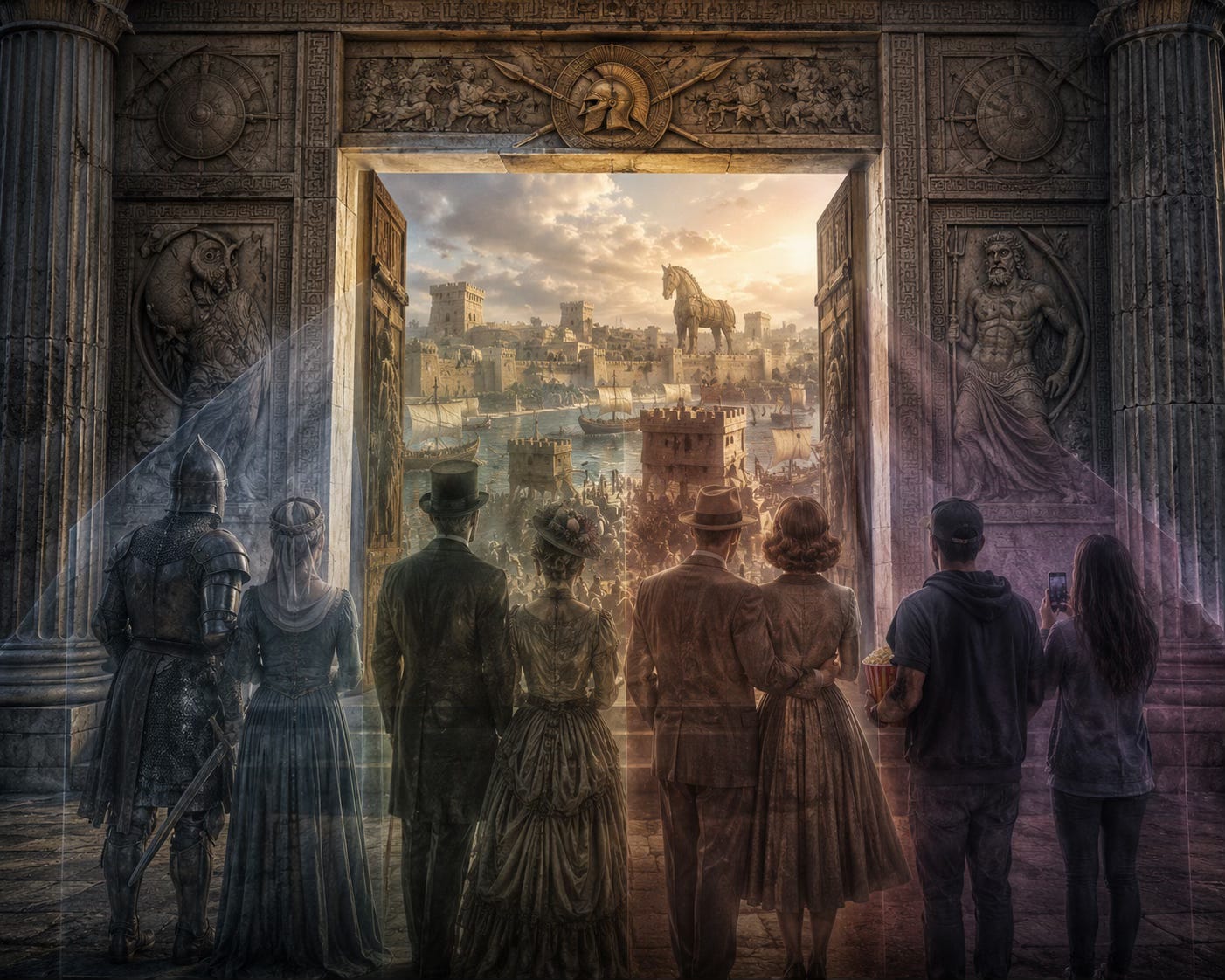
“Before this year ends, Grok Imagine will make a full-length movie of The Odyssey that is historically accurate and true to the art of Homer.”
— Elon Musk
I’m not saying it’s impossible…
You know what? I am saying it’s impossible. It can’t be done.
Not because artificial intelligence is incapable of producing the film. Not because Elon Musk lacks the resources. Not because Homer cannot be translated to English.
The impossible part is the audience.
To be fair, Grok’s version will probably be drastically more historically accurate than anything Christopher Nolan attempted. Homer gets little things right in the Iliad and the Odyssey with a precision that archaeology has repeatedly confirmed over the last century. Enough so, in fact, that you can’t help but wonder whether if got the larger historical picture right as well.
The Troy that Homer describes while not a mythic kingdom did occupy the most valuable piece of real estate in the Bronze Age.
For nearly three thousand years Troy sat astride the Dardanelles. Merchant ships sailing from Greece or the Levant toward the Black Sea had to fight both a fierce current and brutal winds. A heavily laden cargo vessel simply could not row against both. Troy possessed the only practical harbor. There were only about sixty days each year when the winds favored a northbound voyage. Merchants either paid Troy’s fees for food, water, and months of waiting, Or they just sold their cargo to local middlemen who could afford to wait.
Copper mattered but tin was the crude oil of the Bronze Age because bronze required both, and Troy sat at the crossroads where copper, tin, amber, grain, and luxury goods all changed hands. It made the city vastly wealthy and a high priority target for anybody with an army and some time on his hands. Troy’s defenses were legendary for a reason, massive limestone walls up 16 feet thick at the base, with ditches and sloping faces that made scaling and undermining difficult. Towers with overlapping fields of fire, chokepoints, and full gatehouses, the works.
You don’t invest in that kind of infrastructure unless you have serious enemies… Which the Trojans did.
Archaeology has likewise vindicated Homer in surprising ways. Troy VIIa bears unmistakable evidence of violent destruction: bronze arrowheads, sling stones, intense fire, and unburied human remains. It also shows signs of repeated preparation for siege.
There’s no way it was a decade long siege, Mycenaean politics wouldn’t allow for it. More than likely it was a 30 year endeavor that cropped up every few years whenever a warlord was able to scrap together a coalition.
Was there truly a Helen? A Paris? A Menelaus? Perhaps or perhaps not. Queen theft was hardly unknown in antiquity. The problem is not that there is no history. The problem is that there is very little history to reconstruct. Troy VIIa fell during the Bronze Age Collapse, civilizations that are falling don’t keep very good records.
Ironically, that is not what will doom Grok’s Odyssey. The historic reconstruction is the easy part.
It’s the audience is the impossible part.
Stories are not understood on their own terms. They are understood through the lens of the stories the audience already knows by heart.
No one approaches a story as a blank slate. Every audience interprets what it sees through familiar genres, familiar morality, and familiar myths. Those stories become the translation layer through which every new story is understood. That is why a literal visual adaptation of Homer is almost impossible for a modern audience to digest.
The world Homer inhabited is not merely old.
It. Is. Alien.
The Iliad starts with King Agamemnon refusing to stop violating a woman because Apollo told him stop it. Finally he has give in what with Apollo being a god could send a plauge and what not, so he goes out and grabs the woman his top fighter, Achillies was violating. Achilles is mad as hell about that because he’d killed the girl’s father and brothers and sacked her city fair and square. She seems to be in agreement about Achilles being in the right about this.
The modern audience will be expecting, in fact, nearly requiring that the movie stop for frequent alter-calls so all of these things can be condemned. A literalist interpretation won’t be doing that at all.
Homer does no such thing. He assumes his audience already understands the world these men inhabit. The conflict is about honor but the audience will be too shocked by its world view not be looked after to pay attention to that.
Let’s take Paris and Helen for an outstanding example
A medieval audience, steeped in courtly romance, naturally saw Paris and Helen as doomed lovers.
Victorians, raised on domestic morality, tended to divide Helen into either the innocent victim or the wicked temptress because those were the categories they already knew.
Modern audiences often read the Iliad through the lens of Hollywood romance or psychological realism, asking whether Helen “found authentic love” or whether Achilles has PTSD. Those are modern questions, and Homer would have been confounded by all of them. Every age remakes Homer into the stories it already knows. Hollywood has been doing it for more than a century.
La caduta di Troia (1911) survives largely because it was ambitious enough to preserve. Eight hundred extras. Massive sets. Huge ships. It also immediately transformed Homer into something its audience already recognized. Modern audiences would see what they were expecting to see even if Homer would not.
Ulysses (1954) is the Kirk Douglas version of what is basically the Odyssey with Odysseus getting the latin rebrand “Ulysses” because that was the name that was legible to American audiences. . An odd little Americanism that is probably left over from the civil war. It was an Italian co-production so leaned into the mythology as far as the Italians could push it.
Helen of Troy (1956) This movie is an interesting artifact because of all of the needles it has to thread to get past the Hays office. First of all Helen is married which means she has to be somewhat justified for running off with Paris, so Menelaus has to be a wife beating brute. . She and Paris have to be in love, in the Iliad, there is no evidence of Helen being a willing participant and plenty that indicate that she loathed Paris, but regardless, there is five hundred years of romantic tradition claiming she was a willing partner and it’s a lot easier to go with that then explain Bronze Age attitudes of ‘unwilling, but I’ve been captured so I guess I have to.’ An important point is that Troy’s destruction has to be morally justified. When the Trojan Horse is brought in, the Trojans hold a fully dressed Hollywood orgy like the audience was used to seeing in biblical epics. Truthfully, this one had a LOT of biblical imagery throughout. Because again, you have to tell the story the audience can understand, the story has to be legible
L’Odissea (1968) No complaints about this one. I mean none at all. Moving on fast before it derails my whole argument.
The Odyssey (1997) with Armand Assante sands down Odysseus’ roughest edges into a more conventional television hero. Penelope becomes more wounded than cunning. Telemachus is reduced to almost nothing. The gods retreat backstage but at least they are there. Even so, it remains far better than its budget should have allowed.
Helen of Troy (2003) This one will give you just a moment of, “hey, somebody read Homer,” then it does its own thing for the next ten pages. Menelaus was for once portrayed sympathetically, even if he came across as a pathetic cuck. Its most egregious deviation was in having Agmemnon violate Helen in front of his brother at the fall of Troy, this was before Chlymenstra murdered him for sacrificing their daughter. It was lazy emotionalism. We have to make Agamemnon extra evil before his end. It also had the absolute worst Trojan Horse of all time. It felt like a high schooler had done his best with MS Paint. You could tell the budget had completely run out.
Then came Troy (2004).
People ask my opinion of this film surprisingly often. Fine. I hated it. Brad Pitt gives a respectable Achilles. Everything else collapses into modern romantic fantasy. Paris and Helen become star-crossed lovers without the tragic ending. Despite bringing ruin upon two civilizations, they escape because the studio feared audiences would dislike watching Orlando Bloom die. Ironically, audiences were far less forgiving of the coward surviving than the filmmakers anticipated.
Finally there was Troy: Fall of a City (2018).Troy Fall of a City (2018) “A bold reimagining by the BBC” That tells you literally everything you need to know about it before the opening credits rolled. At least Nolan’s version is shorter.
Every adaptation has done exactly the same thing. Not because the filmmakers were incompetent. Because they were translating Homer into stories their audiences already knew how to read. That is why Elon Musk’s challenge is impossible. Grok may very well create the most historically accurate adaptation ever filmed. The armor may finally resemble Bronze Age armor. The ships may finally resemble Bronze Age ships. The palaces may finally resemble Mycenaean palaces. The walls of Troy may finally resemble the city archaeologists have spent the last century excavating. None of that is the difficult part.
It’s not that Grok can’t reconstruct the Bronze Age. It’s that it can’t reconstruct a Bronze Age audience.
Stories are not understood on their own terms. They are understood through the lens of the stories the audience already knows by heart.
Every generation remakes Homer into its own image because it cannot help itself. Medieval Europe found courtly lovers. Victorian England found morality plays.
Hollywood found tragic romance. Modern prestige filmmaking finds trauma, psychology, and contemporary politics as instinctively as a duckling follows its mother.
Grok may faithfully reconstruct Homer’s world. But it cannot make modern audiences see it through Homer’s eyes.
Discuss in the Comments Below
Your points re. storytelling and audience are correct. The question of success or failure, however, will depend on the metrics and the purpose. The original proposal put out on Twitter by John Carter was for Musk to hand Mel Gibson 100 million to make the movie historically accurate and in the original Greek - in which case, all your points about audience and storytelling are correct, and the result would likely be a beautiful flop.
Having Grok do it suggests an entirely different set of metrics and thus a different standard for success. Historically accurate Odyssey will never be a blockbuster, but this by no means indicates a failure. To the contrary, a beautifully-created rendition, made without all the constraints of real actors, sets and scenery, produced faster and cheaper than anything the Studios could create today might be a success even if produced at a loss - if the purpose is to inspire people to turn to Grok or other AI platforms and bypass the current system altogether.
So much of the pre-Iliad mythology - the circumstances that led to the Trojan War - is entirely overlooked in this assessment.
The shunning of Eris at the wedding of Peleus and Thetis, and her delivery of the golden apple….
The beauty contest between Athena, Aphrodite, and Hera (yes, the entire war came about because of three women arguing over which was prettiest)….
Aphrodite bribing Paris with the love of any mortal woman….
Helen willfully running off with Paris (her agency is demonstrated in the Odyssey when she tries to provoke the Achaeans hiding in the horse into exposing themselves)….
Etc.
The audience is there, if it’s done well and the right version of the story is told.
Bear in mind, Homer was writing 400+ years after the events in question. His own audience would not have been as informed about the legendary world in question as the article suggests.