

Woke Didn’t Destroy AAA Gaming
The Failure of Fortnite - The Plastic Age of Gaming

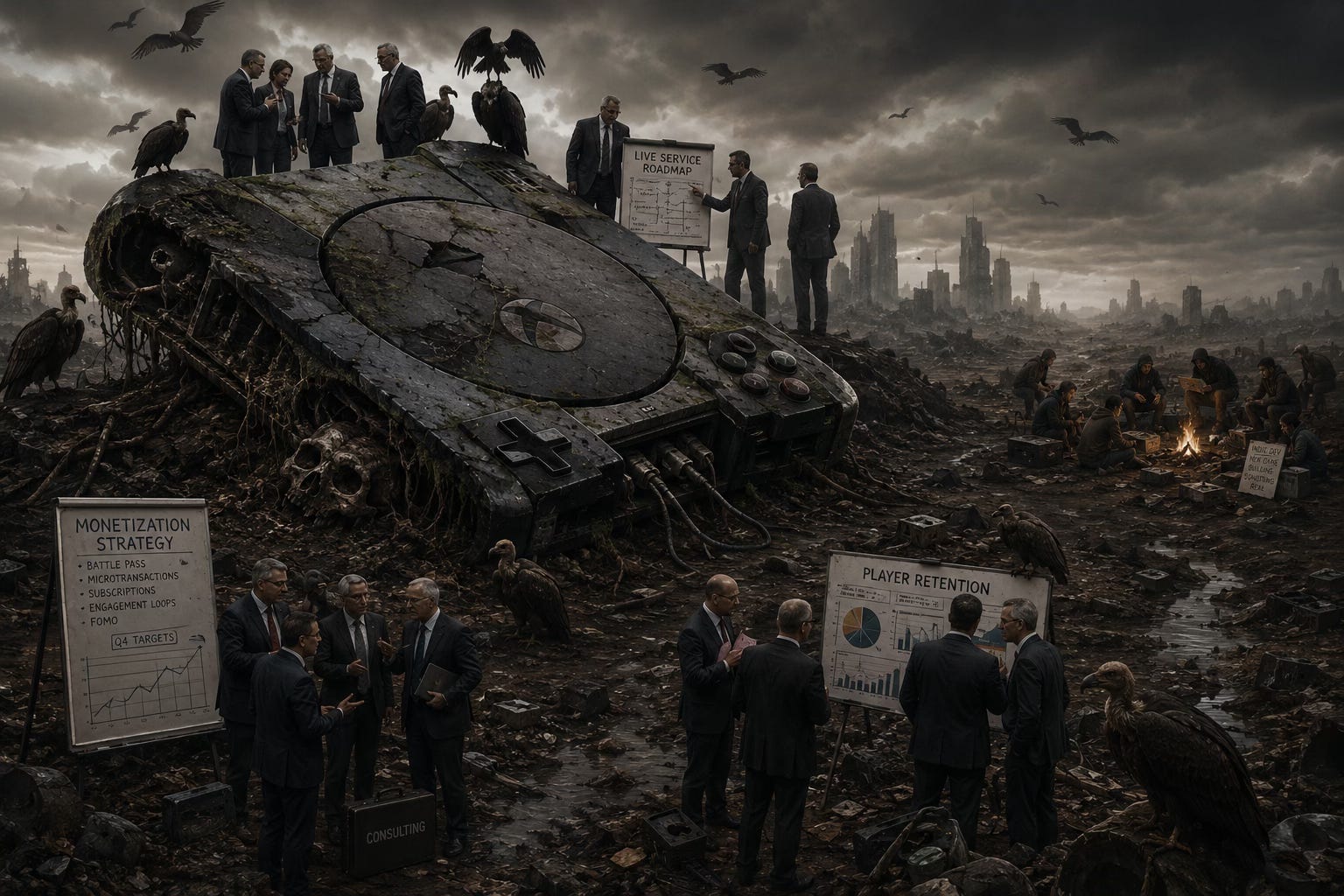
Woke is the blood soaked handkerchief after a coughing fit. Woke is the bulge in the lower abdomen starting from your colon. Woke is just the last gross symptom that appears when the patient is too far gone to be saved.
It didn’t cause the disease. It is the final result of the disease.
All these guys who are convinced that various companies are getting rid of the Woke make me laugh. First of all they won’t get rid of Woke, they’ll just call it something else but even if they did, that is just treating a symptom and not the underlying terminal condition. Which is this:
There is no AAA gaming industry, there is only the tattered remains of a Fortnite Industry.
Just as DVD marketing executives in Hollywood were never promoted for their ability to recognize a story, executives at AAA gaming companies were never promoted for their ability to create a great game. They got bumped for things like:
-monetization,
-retention,
-engagement,
-platform growth,
-recurring revenue.
They got promoted in a desperate attempt to get on the Fortnite gravy train. The entire industry was rebuilt to try and recreate a unique fluke and in so doing, destroyed itself completely.
And the sad part is, it wasn’t really the fault of the companies, it was the institutional investors who are the real owners. There might be one or two that don’t have an abacus for a heart but generally speaking they aren’t allowed to get ahead. You can explain the numbers to an institutional investor and at first they’ll seem like they understand.
A modern AAA game may cost $200–300 million+ to make. If it sells 5 million copies at $70, that’s roughly $350 million gross before platform cuts, marketing, and discounts. Nobody likes to make just break even money. A big hit like Doom Eternal can come in at $450 million and Cyberpunk 2077 hauled in $560 million in its first year.
A runaway hit like Helldivers II makes $700 million. And once in a great while you get a seismic event like Hogwarts Legacy and Elden Ring that breach the $1 billion ceiling. Sidenote: Cyberpunk 2077 did clear that bar eventually.
And none of that matters, because every institutional investor in existence has their eyes focused hypnotically on Fortnite’s annual revenue of $6 Billion a year. The command was as inevitable as it was delusional, “Go do that instead.”
Almost the entire AAA industry became utterly obsessed with monetization over night. The only people getting hired and promoted to management were people coming up with schemes to inject monetization into everything from Diablo to Dungeons and Dragons.
The sad truth being Fortnite isn’t really a game. Not to the kids playing it
For the Gen Alphas that have taken it away from Gen Z at this point Fortnite is just the place their friends are, it’s where the latest concert is, the spot where the new movie tie-in appears. It’s where they show off their new skins. But mostly it’s the place they chat while doing something with their hands. The game, (not that it was ever much of a game) is just background activity. From that perspective it’s more like the Metaverse from Snow Crash. They didn’t set out to create Stephenson’s online universe; they just stumbled into it. Although Epic has gotten closer than Zuckerberg ever did.
The important thing is this, kids don’t say, “Let’s play Fortnite,” they say, “Meet me on Fortnite.”
Fortnite succeeded because it accidentally became something no executive had ever planned for: a digital third place. Earlier online games were places people went to play a game. Fortnite became a place people went to meet their friends. It arrived at precisely the right moment, free-to-play, available on nearly every platform, easy enough for children to play, and backed by Epic’s ability to update it at a pace that competitors couldn’t match. Then the game itself became almost secondary. Concerts happened there. Movie promotions happened there. Kids showed off skins there. They chatted there. They hung out there. By the time institutional investors noticed what was happening, Fortnite was no longer competing with Call of Duty, Battlefield, or Overwatch. It was competing with Discord, TikTok, YouTube. and the shopping mall. The tragedy is that executives looked at this once-in-a-generation lightning strike and concluded they were looking at a reproducible business model. They weren’t. They were watching a social phenomenon masquerading as a video game.
You. Can’t. Recreate. That. With. Overwatch.
But all the people who are suddenly getting hired at six digit salaries, were being hired to do exactly that and they weren’t going to listen.
Hear now the roll call of the fallen:
WARNER BROS. DISCOVERY — The Zaslav Doctrine
The most grotesque example of executive brain damage on display is Warner Bros. Discovery CEO David Zaslav. Rocksteady Studios; the team that built the legendary Batman Arkham trilogy was handed a live-service looter shooter called Suicide Squad: Kill the Justice League. The live-service model had been pitched internally as early as 2016, and as the years went on, executives grew increasingly enthusiastic about it. Countless presentations extolled the virtues of continuous monetization and player engagement models. The result was, in the words of the gaming community, a bland sandbox populated with recognizable characters and nothing else.
According to Bloomberg and reporter Jason Schreier, Warner Bros. lost $300 million in 2024 from the combined failures of Suicide Squad and Harry Potter: Quidditch Champions. David Haddad, the head of the game division, resigned. And what did CEO David Zaslav do in the immediate aftermath? He announced plans to double down on developing games with live-service models.
It gets worse. Despite that $300 million combined loss, a new job listing appeared at WB Games Montreal the studio behind Gotham Knights for an executive producer to lead a “high-quality AAA game” emphasizing “post-launch operations” and a “live-service strategy.” The gambler who just blew his mortgage at the roulette table is asking for directions to the ATM.
EA — Andrew Wilson Explains That Water Is Actually Too Wet
EA CEO Andrew Wilson delivered perhaps the single most jaw-dropping executive statement in the history of the industry. After Dragon Age: The Veilguard crashed and burned, Wilson suggested during a quarterly financial call that the game struggled because it didn’t have any live-service components.
Dragon Age had originally been developed as a live-service title, known internally as Dragon Age: Dreadwolf, before being rebooted to remove those elements. Wilson’s comments suggest he views that pivot away from live service as what killed it mistake. And not the fact that the entire game was filled with insufferable, detestable characters.
Former Dragon Age creative director Mike Laidlaw responded publicly, saying he wasn’t “a fancy CEO guy,” but if someone told him the key to a successful single-player IP was to make it purely multiplayer, he’d probably quit. Meanwhile, Wilson noted on the same earnings call that 74 percent of EA’s business currently stems from live-service games. The man is so deep in the casino he’s forgotten there are windows.
This is also the company that, facing the failure of Battlefield 2042 released without a campaign, stated publicly that “players don’t want single-player games anymore.” Battlefield 2042 then underperformed massively. EA has been wrong about this in the same direction, repeatedly, for years.
SONY — Jim Ryan’s $3.6 Billion Mistake
Former PlayStation CEO Jim Ryan decided Sony needed to be in the live-service business in a serious way. He acquired studios specifically to build toward a stated goal of 12 live-service titles by the end of fiscal year 2025. Sony acquired Firesprite, Fabrik, Valkyrie, Firewalk, Haven, and Neon Koi, with Bungie being the most significant purchase.
The result: Concord. Developed by Firewalk Studios, it launched in August 2024 and was taken offline within two weeks. Sony then closed Firewalk entirely a quick calculation across Bluepoint, Firewalk, Neon Koi, Sony Bend, Bungie, and others reveals the live-service push cost over 1,500 employees their jobs at Sony.
Sony originally wanted to have 10 live-service games released by 2026. So far, only a handful have come out, one of which is now synonymous with total failure. Securities analyst Michael Pachter was blunt: Sony lacks expertise in free-to-play live games despite spending $3.6 billion on Bungie.
And PlayStation’s current studio CEO Hermen Hulst’s response to all of this, in an official statement? “We will take the lessons learned from Concord and continue to advance our live service capabilities to deliver future growth in this area.”
THE GRAVEYARD — Just the Body Count
The conventional wisdom flipped on its head. Fortnite was the reason these companies chased the live-service trend in the first place, but it also became a gatekeeper — the reason so many of its competitors failed. Fortnite had captured too great a number of players, and the cost of luring them away was too steep.
In 2024, the video game industry experienced record-breaking layoffs exceeding 13,000 positions, reflecting a sharp post-pandemic correction. Many initiatives failed to achieve player retention metrics essential for ongoing monetization, with high-profile efforts requiring massive post-release investments that proved unrecoverable when user drop-off rates exceeded expectations. GrokipediaGrokipedia
The punchline that ties it all together: Fortnite itself had around 650 million registered users in 2024, but despite regular updates and constant celebrity crossovers, daily active users dropped sharply. Epic Games CEO Tim Sweeney said the company needs to lose staff because it simply can’t afford to keep them on. Epic eliminated 1,000 positions in 2025, with Sweeney admitting expenses have dramatically surpassed income — the second major round of cuts since laying off 830 people, roughly 16% of the company, in September 2023. The golden goose is sick. And the entire industry set its house on fire trying to clone it.
Darklings: Yeah dude, but these games were still Woke as all hell.
Dark Herald: Unquestionably. And that tells you right there, the marketers were in the saddle and not the game devs.
Mostly because the people that lived to make great games followed the advice of Lord Humongous and just walked away.
The story was repeated constantly, first the studio lost the founders, then lost the creative culture.
The reason was simple and obvious. When you sell a company… IT’S NOT YOURS ANYMORE. And that is exactly what happens when you “go public.” At that point no, matter how super clever you were planning to be in keeping control of your company, you don’t own it anymore. Because you sold it. And the new owners have rights and expensive lawyers, in short order the studio becomes completely investor-owned,management-driven, and since MBAs have no clue at all how to make a game, they become utterly obsessed with metrics.
The jackals from narrative consulting firms are just feeding on a corpse. I promise you Veilguard would have been hot garbage even without the utterly insufferable Tosh because the people who could tell good from garbage were long gone. In their place were MBAs frantically devouring the metrics being fed them by the likes of Sweet Baby Inc.
The patient isn’t going to recover because you changed the handkerchief.
The institutional investors still own the studios. The MBAs are still running them. The metrics dashboards are still the only thing anyone in a corner office actually reads. You could fire every narrative consultant in Los Angeles tomorrow and Rocksteady would still be gone. BioWare would still be a shell. The creative founders who built these companies would still have cashed out a decade ago and gone fishing.
What you’re left with is an industry that doesn’t know how to make games anymore, chasing a phenomenon it doesn’t understand, hemorrhaging the talent that might have saved it, and congratulating itself for switching the terminology around.
The Plastic Age of gaming isn’t ending because someone at a studio said the quiet part loud on a podcast. It ends when the whole rotting structure finally collapses under its own weight — and the next generation of founders builds something new in the wreckage.
That part, at least, has always been how it works.
Discuss in the Comments Below
Great take.
Epic fell into Fortnite, taking its failed Fortnite Save The World, copied PubG, and added a fun factor. My kids were devoted. And it blew up.
Then it changed. It went from being a teen and young adult player base to a place with little kids. Most of my kids refused to play any more.
Chasing the live-service model was like chasing the on-line multiplayer model, and the open-world model.
I read recently that most hours on Steam are games that are over 10 years old.
My young adult sons are huge retro gamers, playing games from 1995 to 2014 mostly.
The industry is dead. It needs a new model.
All sadly true. Fortnite is only fun if you like FPS. These days I need a game I can pause and go deal with something (usually my dogs causing a ruckus or needing to go out).