

The Dark Herald Recommends: David
Angel Studios new musical

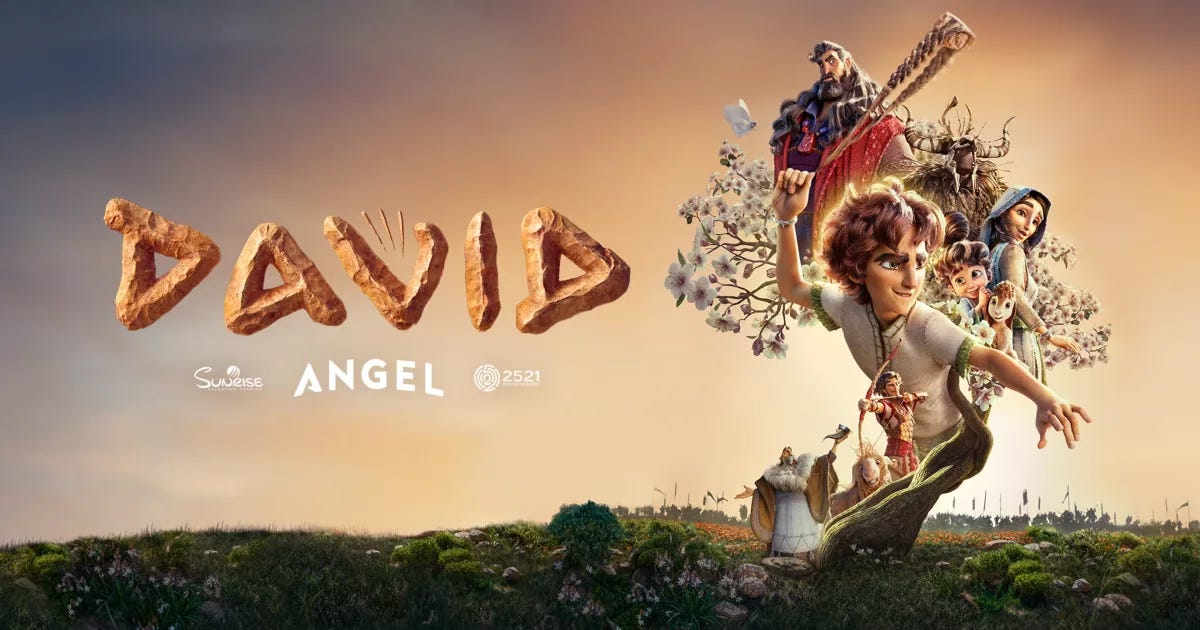
We come to praise Angel Studios not to bury them.
Although, we may well be doing that after Animal Farm comes out but today’s review is on their truly excellent movie on King David.
What it is
No, this isn’t about David’s whole life story, so there won’t be any awkward explanations to your kids about Solomon’s Mom.
This not David the King.
Nor David the Penitent.
It is about David the Called.
It covers his life from his anointing by Samuel, to shortly after the Battle of Mount Gilboa.
Who it’s about
It treats this period as foundational scripture rather than a morality play for kids. That alone makes it worth a good look. David is shown to be a faithful shepard, a talented musician (something that gets frequently overlooked), a devout worshiper and a spiritually led servant of the Lord.
This story is also about Saul and Jonathon, and what it avoids saying about these men show you who this movie is meant for. King Saul’s decline is present but rather simplified. And truthfully it needs to be because the reason Saul’s kingship was torn from him to the utter damnation of his line is one of those big picture theological things on the nature of sin that will leave kids yawning.
These are big and important questions that need to be asked by more developed minds. Sure Saul committed terrible sins but weren’t David’s just as bad? Why did both Saul and Jonathon have to die?
While David sinned and sinned grievously, his failures were those of man. And David was deeply penitent of those sins. He admitted that he had sinned
The Fall of Saul
Saul’s sins were those of a king breaking his covenant with God, he defied direct Instruction. Performed the priest’s functions. He made himself into a king in the fashions of those pagan kingdoms around him and reinterpreted commandments to suit his own objectives. He redefined partial compliance as complete compliance and the Lord was just going to have to see reason on that point. Saul never admitted to having sinned at all. In simplest terms, he was prideful and his sins were those of pride.
Now this aspect of the story is the easiest to show rather than delivering a long theological lecture that would leave kids squirming. And that is what this film does.
Now for all of these reasons the protection of the Lord was withdrawn leaving King Saul spiritually vulnerable. Something that needs to be stressed is that God did not send demons to torment Saul, they were surrounding him and needed no encouragement.
Samuel had already anointed David as the new king when Saul commanded that musicians come and try to dispel the darkness surrounding him. This is shown rather than told by having Saul engulfed in literal darkness and David’s song brings the light that dispels it.
Yes, it’s a Musical
Okay, time to talk about the music. This is in fact a musical, and this aspect of David’s life is frequently (but not always) overlooked by Hollywood.
There are 12 tracks making up 33 minutes of the film’s run time. Interestingly, these songs are not the usual non-diegetic road block to story where everything has to stop while the cast has to sing and dance and not much else for a few. Here the songs are story telling devices in and of themselves, intrinsic to moving the story forward and providing background plot.
The music itself is modern CCM in sound, but psalmic in function.
The verse-chorus structure will remind you of Hillsong, Bethel, Phil Wickham and the like. Definitely not Prince of Egypt. I think this was designed to be accessible to youth ministries to be used in services to torment loving parents.
I am afraid
You are with me
I will trust
You are faithful
The lyrics are clearly Psalm-like in that they are raw-internal dialogs rather than deeply thought out and structured thesis. They are ultimately in terms of song, emotionally accessible.
This is also the part that Jewish people are likely to feel the least comfortable with. There is no Ancient near east color to these songs, no sense of Jewish distinctiveness from modern Christian evangelical culture. The closest you get to a Hebrew cantillation is the song Samuel sings when he anoints David.
The goal of the music is emotional identification, not reconstructing the songs of a bronze age shepherd.
Music is foundational to David’s identity, it was his weapon against the forces that beset Saul, and it was part of his preparation for his own kingship. David was a musician and was never meant to be a Marvel superhero.
Which brings us to his battle with Goliath of Gath.
Spoilers I’m going to tell you who loses
One of the frequent failures of Sunday School is stressing the… Well, David and Goliath nature of the battle of David and Goliath. It lends itself far too easily to a tale of an underdog triumphing against overwhelming forces.
The Champion of God Almighty was not the underdog.
The spiritual nature of the fight was probably the most difficult to bring to the screen. Goliath was more than just a really big dude. He was spiritually corrupt and was born that way. I’m not going into the origins of the Giants of Gath but the fight with David was – spiritually speaking – a lot more than just a contest between champions of kingdoms in a localized geopolitical conflict.
In simplest possible terms, Goliath was literally an orc.
And he was represented that way through subhuman appearance, greyish pallor and his own acknowledgement that this battle was religious in nature.
Something else to keep in mind; slingers were not kids with slingshots, they were a bronze age battlefield elite. Arguably more deadly than archers of the period. Getting hit in the face’s “Golden Triangle” by a rock moving at 100 miles per hour is just as fatal today as it was in Goliath’s age.
The Death of Jonathon
Saul’s deterioration into paranoia escalates until it fractures his kingdom leaving the Kingdom of Israel vulnerable to outside invasion.
Jonathan’s death is going to be one of those things that will need explaining to your kids and you will have to be the one to do it. His death isn’t gorey, in fact there is no kind of body horror at all in this movie, however, there is no question that he dies. Jonathon’s death is shown to be the tragedy it is. Born to be a king, before his father broke his covenant, he was a good and righteous man who would have made a fine king himself. However, he accepted David’s elevation over himself, giving David his own robe, armor and weapons – the symbols of kingship. It was meant to be what it was, tragedy, as a prince he was forced to answer for the sins of his father no matter how good a man he was personally.
Darklings: You have now reviewed the Bible. What about the film?
Dark Herald: Granted.
I haven’t really said anything about the movie as a whole yet. Taking all of its elements together it makes for an excellent family film. I wasn’t at all bored which is frequently a worry when you review a Christian children’s movie. The story was kept well paced despite the thematic weight of its material. The ending is a little weak but this is unavoidable without rewriting the events of the Bible and to be fair the rest of the movie carries it without much effort or strain.
The animation quality is to put it simply, good enough. Nothing exceptional but nothing bad either. It’s not hyper-realistic (which is still off putting), no Pixar flourishes, nor squash and stretch, no “bean-mouth” and no Spiderverse experimentalism either. 24 frames per second so you don’t get any of Sony’s herky-jerky, it’s smooth and fine. The animation is just fine, which is all it really needed to be.
However, its direction and staging are better than its raw animation.
Should I take my kids to see this one? If you are Christian you should have no problems doing so.
This is NOT however a neutral or interfaith or “Judeo-Christian” interpretation of David. This clearly and unapologetically a Christian devotional of the life of David.
Summary
David succeeds because it knows exactly what story it is telling—and just as importantly, which ones it is not. By focusing on David’s calling rather than his reign or repentance, the film avoids both scandal and sentimentality, presenting a spiritually coherent introduction to one of Scripture’s most complex figures without flattening him into a children’s morality mascot.
Its greatest strength lies in its use of music as theology rather than decoration. The songs function as psalms: prayers set to melody, modeling a posture of trust, fear, and devotion rather than delivering didactic lessons. This choice allows the film to communicate spiritual truths visually and emotionally, sparing younger audiences the burden of abstract explanation while still respecting the weight of the material.
The film’s simplification of Saul’s fall is a limitation, but a defensible one. Rather than attempting to explain covenantal disobedience in lecture form, David shows the consequences of pride and spiritual abandonment through imagery, contrast, and tone. The result is not a complete theology of kingship, but an honest and age-appropriate one.
Technically, the animation is competent rather than showy, but the direction, pacing, and staging are strong enough to carry the story. The film moves confidently, never dragging, and treats tragedy—particularly Jonathan’s death—with the seriousness it deserves.
This is not a neutral retelling, nor does it pretend to be. David is an explicitly Christian devotional film, rooted in worship rather than reconstruction, and it makes no apology for that. Families looking for a thoughtful, reverent, and engaging biblical film for children will find this one not merely acceptable, but genuinely worthwhile.
The Dark Herald Recommends with Enthusiasm (4.7 / 5)
UPDATE: I have now been reliably informed that Angel Studios involvement is strictly as the American distributor. They did not produce it.
It showed and didnt tell. The psalm adaptions worked well.
Animation better than many. The tricks they used on big scenes are common, even in videogames.
Kids and most adults under 50 wont mind.
Excellent ! This is going on my watch list.